

BLOG
03 mins read
AI in SD-WAN: Beyond Performance Scores and Pretty Dashboards
Kamali Rajendran
Posted: Dec 10, 2025
Table of Contents
The Truth about “AI-Powered SD-WAN” — Most of it isn’t AI at all The Lie: When intelligence becomes decoration
Over the last two years, SD-WAN vendors have rushed to add “AI” into their marketing. Some renamed dashboards. Some added new charts. Some added an “AI score” or “AI assistant.”
But talk to any engineer running real global WAN infrastructure, and you’ll hear the same thing: “The AI doesn’t actually do anything.”
This “marketing AI” simply visualizes. And visualizing is not intelligence.
How AI Guards Our Data?
It doesn’t:
Predict.
Recommend.
Act.
Learn.
Adapt.
If SD-WAN is going to survive the next decade of multi-cloud, remote work, encrypted traffic, and unpredictable ISP behaviour, Real AI must move from cosmetic → functional.
Why Today’s SD-WAN Is Breaking Under Pressure
SD-WAN started as a brilliant idea: use overlays to secure and optimize connectivity across the internet.
But as networks grew more dynamic, static SD-WAN struggled with:
The world changed. SD-WAN didn’t. Policies written last month might already be outdated today. The industry’s version of “AI” (a performance index, a few anomaly alerts, a bar chart) doesn’t close the loop between observation and action. This is marketing AI, not operational AI.
Tunnel/underlay mismatch: Tunnels look fine, but the underlay is deteriorating.
ISP instability: Performance changes hour by hour.
Cloud-region variability: Latency between regions fluctuates unpredictably.
Encrypted traffic explosion: Traditional QoS logic becomes blind.
The Solution: What True AI-Driven SD-WAN Must Do
To earn the title “AI-driven,” SD-WAN must execute three tightly connected capabilities:
Capability 1: Predict
AI must forecast performance issues before users feel them. Prediction transforms firefighting into prevention. For example:
“This link has an 82% chance of a jitter spike in 10 minutes.”
“Loss patterns suggest an ISP rebalancing event is imminent.”
“Path X→Y shows early signs of packet fragmentation.”
Capability 2: Recommend
Once a potential issue is detected, the AI should provide decision intelligence, not just anomaly detection:
Best path recommendations.
MTU adjustments or tunnel switching guidance.
Application-specific routing suggestions.
Capability 3: Act
Autonomous SD-WAN should apply safe, reversible actions:
Switch from Path A to B.
Rebalance tunnels or adjust DSCP markings.
Bypass unstable cloud regions.
Action is the ultimate intelligence layer. Without action, SD-WAN stays manual. With action, SD-WAN becomes autonomous.
Why AI in SD-WAN Is Hard
The WAN is one of the most chaotic systems in modern computing. Building real AI for it is a monumental challenge because:
This requires an AI model trained on tens of thousands of real path cycles — across multi-cloud, multi-ISP, multi-region routes. Very few vendors have enough path data to train such models.
Telemetry is extremely noisy: Loss, jitter, RTT all fluctuate unpredictably.
Underlay instability hides behind overlays: You see a tunnel, but not the physical path beneath it.
Encryption reduces visibility: DPI signals become limited in QUIC/TLS-first traffic.
ISP behaviour varies by region and time: A path stable at 10 AM may collapse at 6 PM.
How Ticvic Builds Real AI into SD-WAN
At Ticvic, we embed intelligence directly into the SD-WAN decision loop:
Predictive Path Intelligence (PathiQ):
Models that forecast degradation windows with confidence intervals. Click here for more details
Hop-by-Hop Anomaly Detection: Catching instability long before tunnels fail.
Autonomous Route Selection: Policies that learn from outcomes, not just configs
Overlay-Underlay Correlation: To avoid the “tunnel looks fine but users say it’s broken” paradox.
RCA Summaries: AI-generated explanations of why a path degraded and what to do next
This is AI that acts, not AI that decorates.
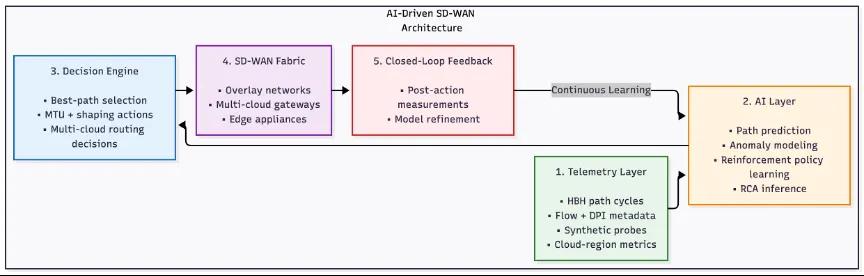
SD-WAN Architecture of the Future
The evolution looks like this:
Most vendors are stuck at step 2. Almost none consistently execute step 4. But step 4 is where SD-WAN becomes future-proof.
Monitoring: “What is happening?”
Insights: “Why is it happening?”
Recommendations: “What should I do about it
Autonomy: “Let me do it for you.”
This is how SD-WAN becomes truly autonomous.
Click here to get more details about AI Enabled SD-WAN
Final Thought
SD-WAN’s next decade won’t be defined by fancy dashboards or prettier alerts. It will be defined by how intelligently and autonomously the system makes decisions — under real network chaos.
The vendors who embrace functional AI — not cosmetic AI — will lead the future of enterprise networking
Related Blogs

How AI & ML Is Transforming The Farming Industry?
The farming industry is poised for a remarkable transformation as it embraces the best technologies available. From precision agriculture and resource optimization to sustainable practices and data-driven decision-making, these technologies have the potential to revolutionize traditional farming methods. By leveraging innovation, farmers can unlock a multitude of benefits, including increased productivity, optimized resource management, enhanced sustainability, and data-driven insights.

Evolution Of Testing From Manual To Automation
Testing is a crucial process in software development that involves evaluating the quality, functionality, and performance of a software system. It is performed to identify defects, errors, or issues and ensure that the software meets the desired requirements and performs as expected.

Cybersecurity - How To Manage Your Digital Identity?
In the wild, wild west of the digital frontier, wrangling your business’s digital identity is like taming a band of unpredictable cyber outlaws. Picture yourself as the digital sheriff; your mission is to maintain law and order in this vast online town.

Create Virtual Machines Using Microsoft Azure, Google Cloud, Oracle Cloud And AWS
In today’s cloud computing, virtual machines are gaining importance since they provide enterprises of all sizes with flexibility, scalability, and affordability. Several well-known cloud service providers stand out for their reliable architecture and extensive selection of choices for creating virtual machines.

Industrial IoT - How Car Manufacturers Use IoT In Their Assembly Lines?
IIoT in the automotive world means connecting every component and device, turning them into data sources that communicate in real-time. Sensors embedded in machines monitor their health, while smart devices oversee quality control. The result is a smooth blend of human expertise and machine precision.

Is Outsourcing A Viable Option In 2023?
Outsourcing is a strategic business practice in which organizations delegate specific tasks, functions, or processes to external third-party service providers rather than handling them in-house. This approach offers numerous advantages, including cost savings, access to specialized skills, and increased operational efficiency.

Agile IT Product Development
Agile IT Product Development has become a buzzword in the software development industry in recent years, as businesses strive to keep up with the fast pace of technological advancements and changing market demands. In essence, Agile is a methodology that emphasizes iterative and collaborative development, continuous improvement, and customer feedback.

Flutter 2023 And Beyond
In 2023, Flutter stands at the forefront of the mobile app development landscape, continuing its remarkable journey of growth and innovation. This open-source framework, developed by Google, has evolved from its initial release into a versatile powerhouse, offering an extensive set of tools and capabilities.

MongoDB Lets Developers Say No To Structural Databases.
When it comes to database systems, developers have a lot of options to choose from. There are traditional relational database systems, such as MySQL and Microsoft SQL Server, as well as newer NoSQL database systems, such as MongoDB and Cassandra.

Advantages Of Using SDN & SD-WAN
The network is the backbone of any business. It is responsible for connecting people and devices, and it enables the flow of information and resources. A well-designed network can be a powerful tool that helps businesses run more efficiently and effectively.

The Future of Networking Is Autonomous — Not Automated
Cloud networking has quietly crossed an invisible threshold.More clouds. More edges. More tunnels. More devices. More telemetry. More failure modes no human can track in real time.

Beyond Hop-by-Hop Path Analysis: The Missing Layer in Modern Network Observability
Hop-by-Hop (HBH) Path Analysis is the missing layer because it reveals the truth about the path, not just the endpoints.

Network Failures Are Not Random: Unmasking the Deterministic Patterns of the “Dark Space” — Part I
If you’ve worked in networking long enough, you’ve heard this sentence hundreds of times. A user complains, a service slows down, or a region disconnects

From Monitoring to Autonomy: Building the Predictive Network — Part II
In Part 1, we debunked the myth that network failures are random. We explored how traditional tools miss the “Invisible Middle Mile” and why Hop-by-Hop (HBH) analysis is the required telemetry layer to see the deterministic patterns behind every outage
Why AI-Native Network Operations Are Inevitable
The networking industry is approaching a critical inflection point. For decades, the Command Line Interface (CLI) has been the primary tool for the network engineer.

Why Traditional CLI-Driven NetOps Is Breaking?
Walk into any modern Network Operations Center and you’ll see the same pattern repeating itself.

How Network AI Agents Think Before They Act? From Automation to AI-Native NetOps.
The conversation around AI in infrastructure has reached a fever pitch, but much of what is being proposed sounds, frankly, dangerous to the seasoned engineer.

Beyond Brittle Scripts: The Rise of AI-Native NetOps
The networking industry is reaching a critical inflection point. For decades, the Command Line Interface (CLI) has been the primary tool for the network engineer, but as infrastructure scales in complexity, manual management is no longer sustainable .

Why the “Decoupled” Agent Model Beats the Monolithic Script.
Traditional automation has been a game-changer, but we are reaching a scaling limit where the network’s complexity outpaces human reasoning.

Why Free-Form AI Has No Place in Network Automation
We built an AI agent that does not autonomously execute network commands by design.

The 5 Forces Reshaping Network Operations in 2026
Over the past decade, enterprise networks have transformed from static infrastructure into dynamic, business-critical platforms.
Can Dynamic Nullforming Make NTNs And 5G Share Spectrum Without A Fight?
SoftBank just ran an interesting experiment in Japan: use dynamic nullforming on an aerial base station so a non‑terrestrial network (NTN) can reuse the same 1.7 GHz band as a terrestrial 5G site without stepping on its toes

Let's talk.
Need a Consultation!
Need help in turning your idea into a successful product? Talk to us. We can help you build your product quickly and ensure it can scale infinitely.
Let's talk.