The biggest myth in network reliability is that failures "come out of nowhere" -- in reality, most begin in the invisible middle miles between endpoints that simple round-trip-time monitoring never examines. Predictability emerges when you combine three layers of visibility beyond RTT, turning an apparently random failure into a detectable, deterministic pattern.
"The network just dropped… no idea why."
If you've worked in networking long enough, you've heard this sentence hundreds of times. A user complains, a service slows down, or a region disconnects. You look at the dashboards — everything is "green." You check device health — all good. You inspect tunnel status — it's "UP."
Yet, the application is struggling. It feels random. It feels like chaos. But the reality is that networks don't fail randomly — they fail deterministically. We just haven't been looking at the right layer of data.
The Single Biggest Myth: "Failures Come Out of Nowhere"
The industry has long operated under the assumption that network glitches are "acts of God" — unpredictable events that we can only react to. This is a myth. Most network failures follow specific, measurable patterns:
- Gradual congestion build-up
- Carrier backbone shifts
- ISP peering imbalances
- Reverse-path degradation
The problem isn't the lack of data; it's the type of data. Traditional monitoring measures outcomes (RTT, loss, uptime). To predict a failure, you must measure behaviours.
Where Failures Truly Begin: The Invisible Middle Miles
Most monitoring tools focus on the edges: the device health and the interfaces. But in a cloud-first world, the "Invisible Middle Mile" — the space between your SD-WAN edge and the Cloud Service Provider (CSP) — is where performance goes to die.
Standard traceroutes and pings are "best guesses" that fail to capture the reality of this dark space. They can't see behind overlays, they are confused by load-balanced paths, and they miss the silent packet drops occurring at hop 6 of a 12-hop journey.
The Behavioural Shift: Beyond Round-Trip Time
To move from reactive to proactive, we must stop obsessing over simple RTT. A stable average RTT can mask a "Phantom Outage" caused by asymmetric routing — where the forward path is healthy, but the return path is traversing a congested peering point.
By analysing Hop-by-Hop (HBH) Path Intelligence, we start to see the network as a behavioural system. We see the exact segment where jitter originates and the precise carrier transition where MTU fragmentation begins.
Predictability Emerges When You Combine These 3 Layers
Here's the formula:
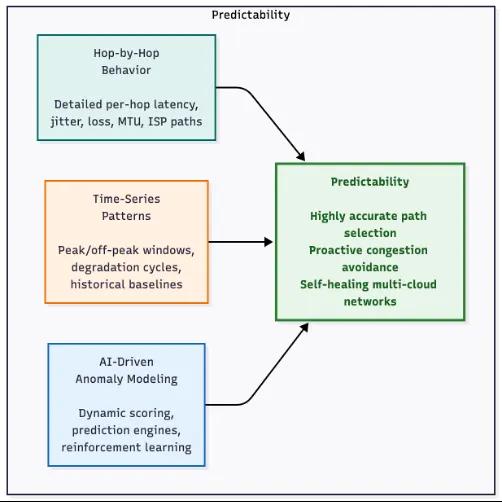
What looked like "random drops" are actually predictable cycles. But how do you translate these mountains of hop-by-hop telemetry into actual uptime? How do you move from simply seeing the problem to preventing it before the first packet is even dropped? More on Part II.
See this running in production — the PathMetrics case study
Illuminate the Invisible Middle Mile
If you're currently managing complex multi-cloud or SD-WAN environments and the "All Green" dashboards are failing your team, it's time to change your telemetry strategy. We've helped engineering teams illuminate the "Invisible Middle Mile" and turn reactive firefighting into precision diagnostics.