BLOG
03 min read
Can Dynamic Nullforming Make NTNs And 5G Share Spectrum Without A Fight?
Thiyagu Ganesan
Posted: Feb 21, 2026
Table of Contents

What SoftBank Actually Did
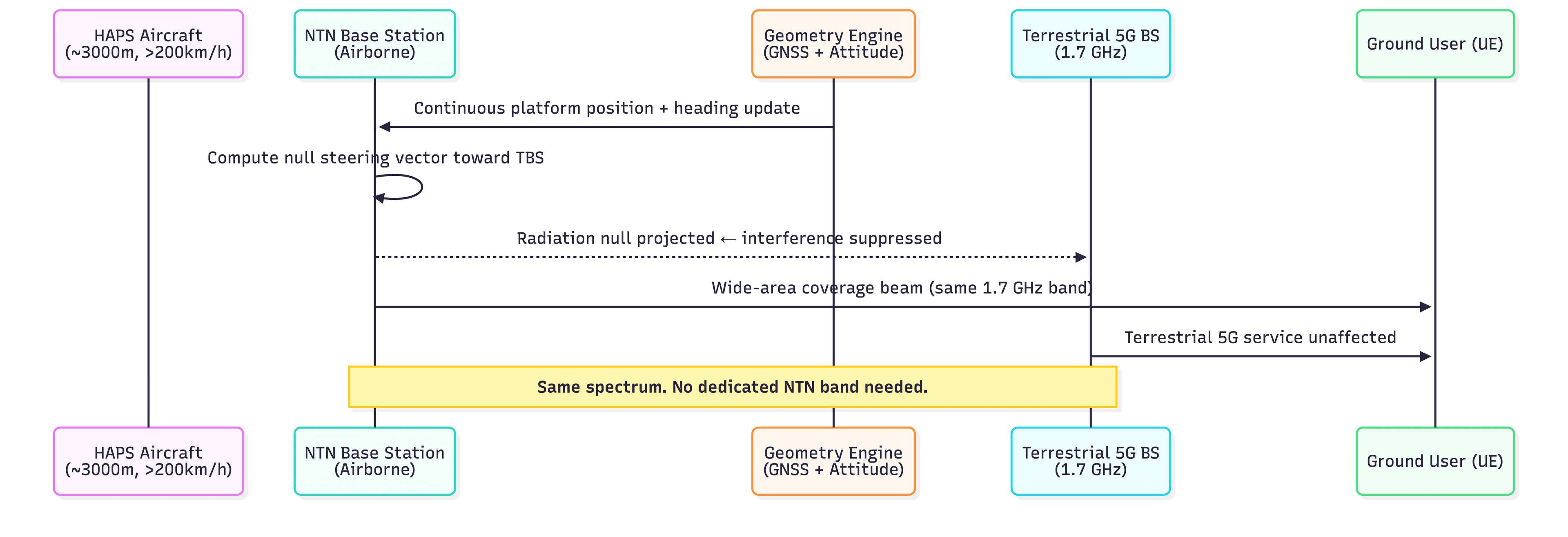
A few details matter here. SoftBank used a light aircraft to emulate a HAPS platform, flying at around 3,000 meters with a maximum ground speed above 200 km/h, and mounted a base station on it that transmitted in the same 1.7 GHz band as a terrestrial site. By dynamically steering a radiation null at the terrestrial base station’s location, they could keep interference “stably suppressed” in its vicinity while still providing wide‑area aerial coverage.
SoftBank’s stated goal is to take this toward HAPS‑based mobile services for hard‑to‑reach areas and emergency communications, with a pre‑commercial launch still notionally targeted for 2026 using LTA platforms from Sceye, and HTA platforms later.
Why This Matters For Operators
From an operator’s point of view, dynamic nullforming addresses two chronic anxieties around NTNs:
Spectrum scarcity:
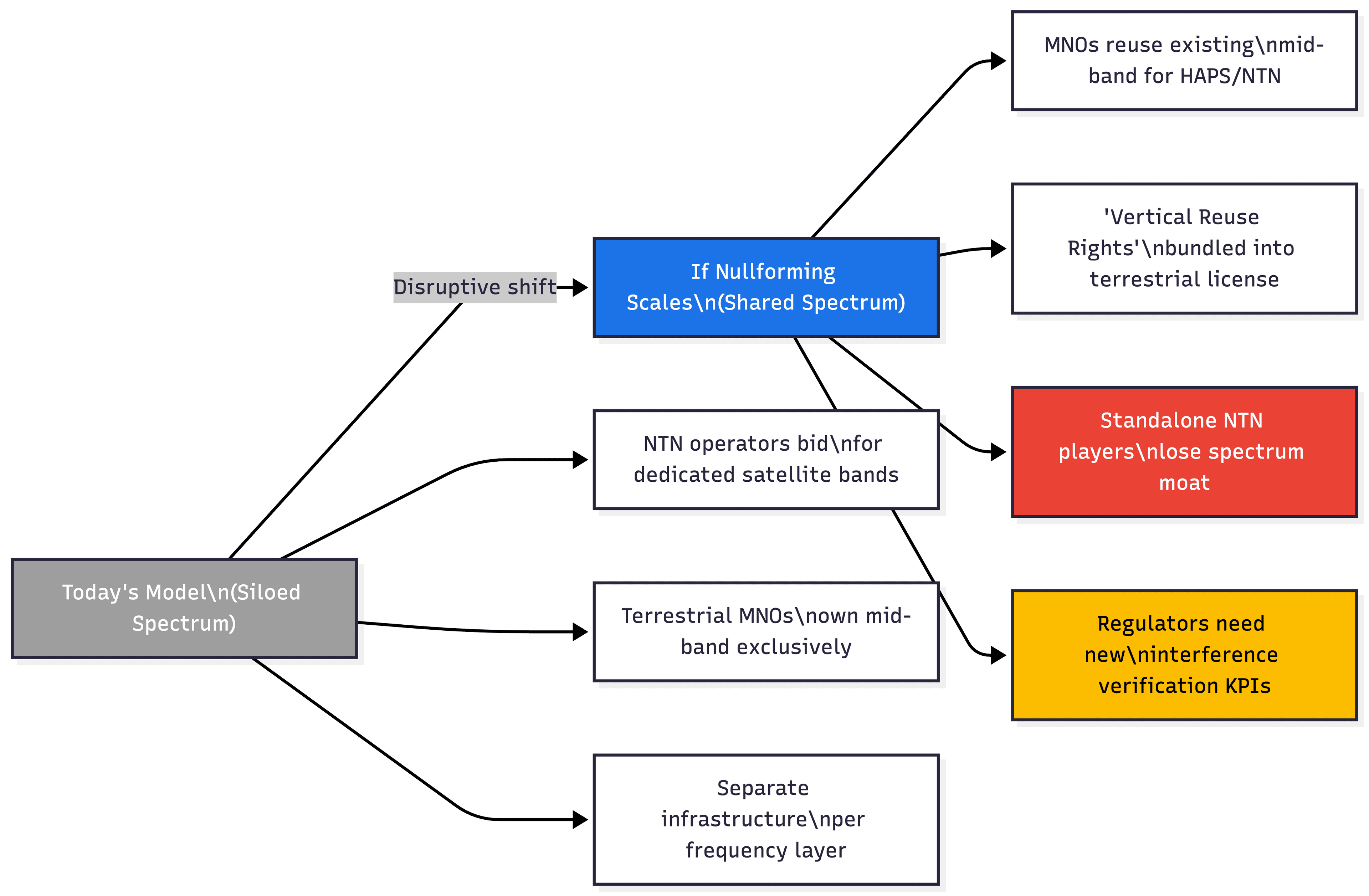
Reusing existing mid‑band (like 1.7 GHz) instead of hunting for “clean” NTN bands could drastically simplify spectrum strategy and regulatory wrangling.
Coexistence risk:
Demonstrating that you can fly an aerial base station over an existing macro site, share the band, and still not degrade terrestrial QoE is a strong story for regulators and CFOs.
But this also raises hard questions:
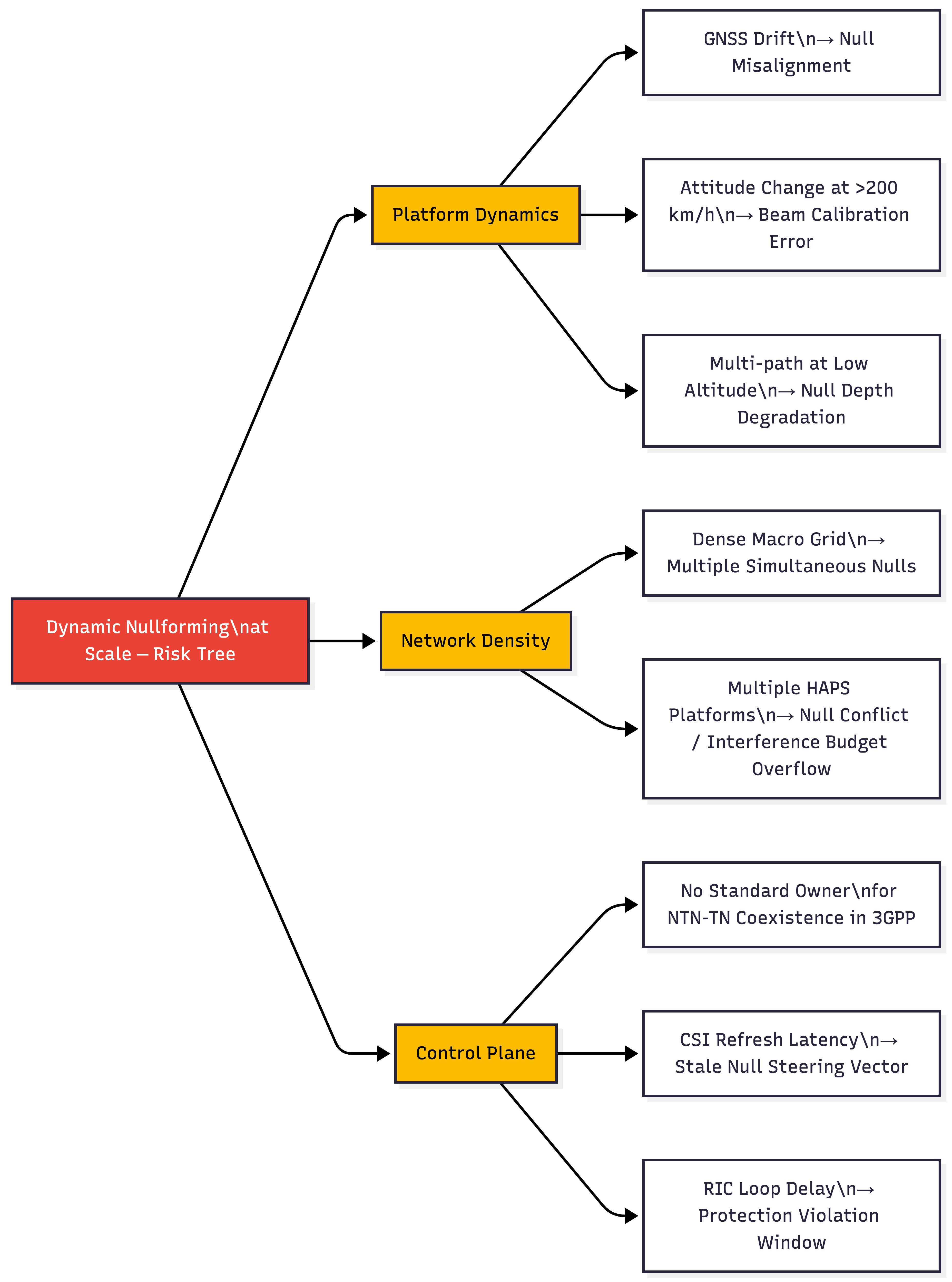
How do you industrialize geo‑accurate null steering in real‑world HAPS or LEO fleets with fast dynamics, multipath, and imperfect location data?
What happens when you have dense grids of terrestrial sites plus multiple aerial platforms all trying to carve out dynamic nulls at once?
To me, this feels less like a one‑off “cool demo” and more like a pointer to how spectrum‑sharing between terrestrial and non‑terrestrial systems will actually be forced to work.

The Technical Questions We’re Not Talking About Enough
If you peel back the PR, several deeper design questions pop up that I’d love to see the community debate:
Nullforming at scale:
It’s one thing to steer a null at a single known terrestrial BS; it’s another to maintain accurate nulls for dozens of sites while your platform is moving at high speed and experiencing drift, attitude changes, and beamforming calibration errors.
CSI and control‑plane overhead:
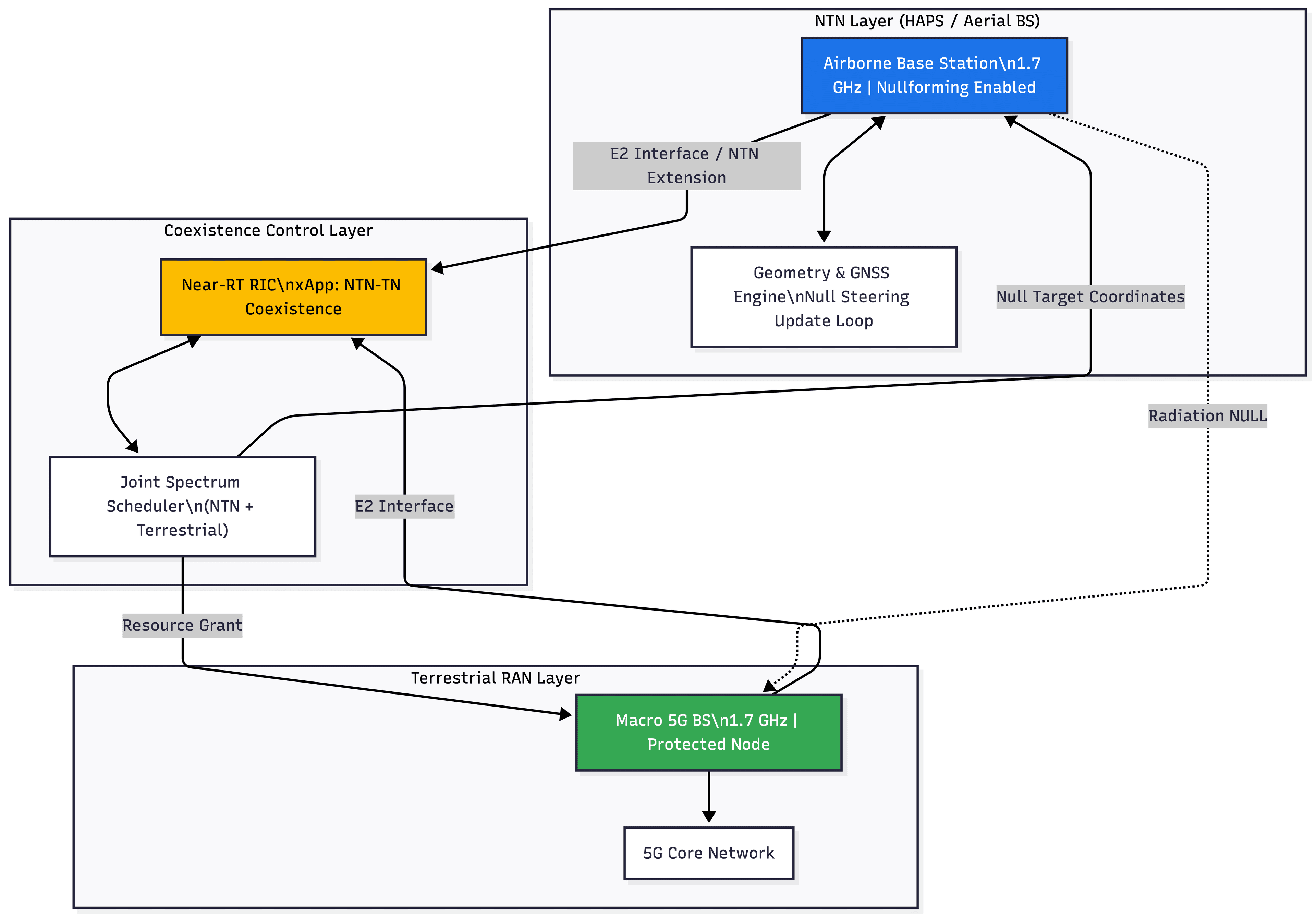
How frequently do you need to refresh geometry and channel state to keep the null “tight” enough at 3,000+ meters, and who owns that control loop (NTN controller, terrestrial RAN, joint scheduler)?
RAN scheduling logic:
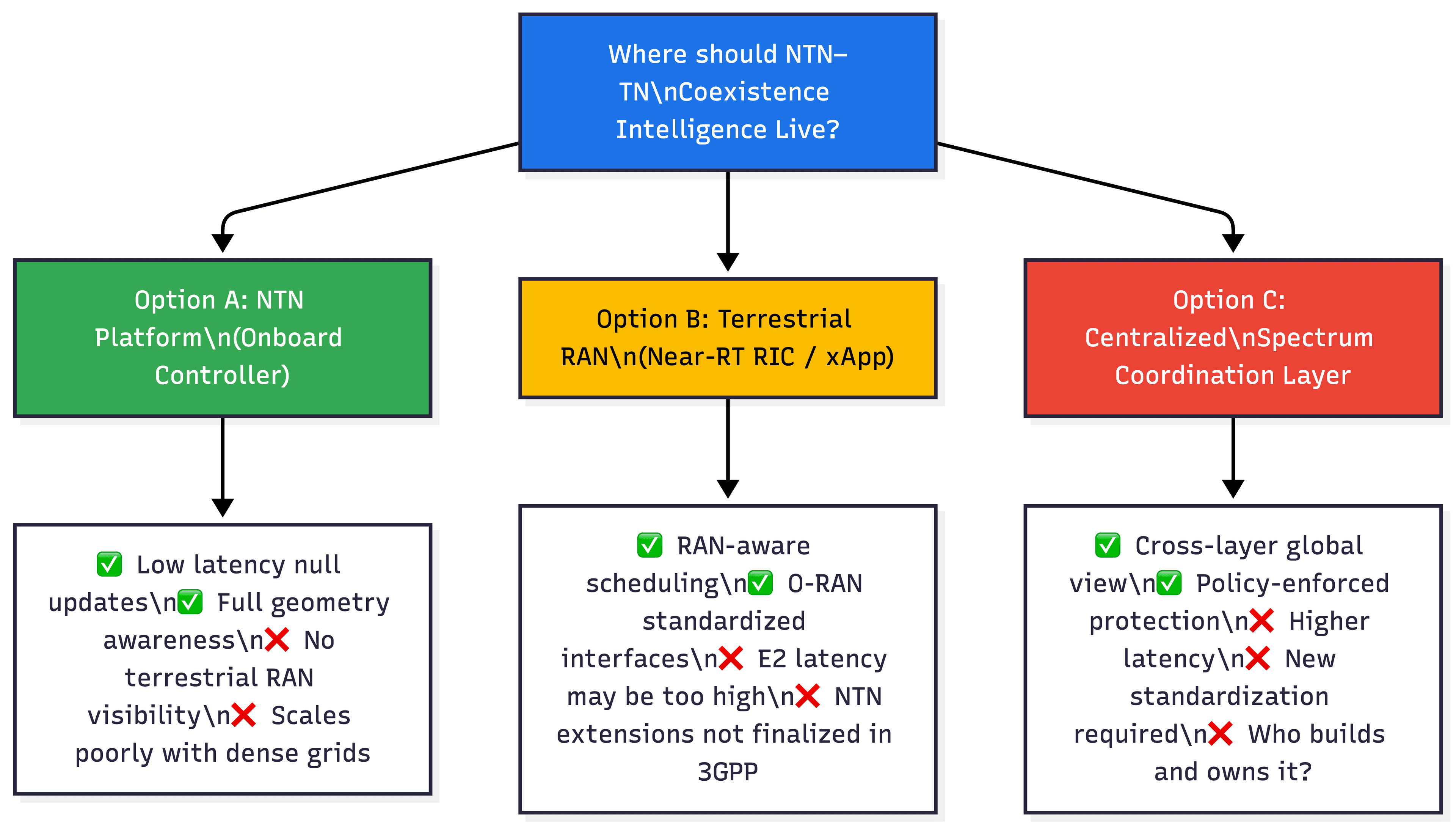
Do we treat NTN cells as “overlay neighbours” with explicit protection rules, or do we push coexistence logic into near‑RT RIC apps (e.g., xApps/rApps) that understand both aerial and ground layers?
For vendors building HAPS payloads or massive‑MIMO arrays, this is a nice forcing function: beamforming can no longer be just about directing gain at users; it now has to continuously direct “anti‑gain” at protected assets on the ground.
Business And Policy Implications
SoftBank’s trial hints at some non‑obvious business and regulatory angles too.
Spectrum licensing models: If NTNs can reliably share terrestrial bands, do we see new licensing categories where terrestrial MNOs lease “vertical reuse rights” to NTN operators, or do integrated players like SoftBank keep the whole stack?
Coverage economics: If an aerial layer can reuse the same mid‑band spectrum with acceptable interference, does it become a more attractive option for rural coverage and disaster‑recovery versus incremental macro build‑outs?
Standardization gap: 3GPP has laid groundwork for NTNs, but do we need more explicit specs for dynamic nullforming‑based coexistence, especially around measurement/reporting and cross‑layer coordination?
These questions will likely decide whether HAPS/NTN is a niche emergency‑only play or a mainstream extension of the RAN.

Over To You – Let’s Debate
I’m curious how others in the community see this, especially those working on RAN design, NTN, or spectrum policy.
A few prompts to kick off the discussion:
1.Do you believe dynamic nullforming is resilient enough for large‑scale NTN–terrestrial spectrum sharing, or is this only viable in low‑density scenarios?
2.Where should the intelligence live for this kind of coexistence – in the NTN platform, in the terrestrial RAN (e.g., via RIC/xApps), or in a higher‑level spectrum controller?
3.If you’re an operator, would you rather:
Keep NTNs in separate bands for simplicity, or
Accept added design complexity in exchange for reusing your existing 4G/5G spectrum?
4.How would you model and test worst‑case interference events here – e.g., sudden platform misalignment, GNSS failure, or a surge of terrestrial traffic near a protected site?
5.What KPIs would convince you that HAPS‑based sharing is “production ready” (e.g., % time interference below threshold at macro sites, delta in cell‑edge user throughput, outage statistics during aerial maneuvering)?
If you’ve run similar trials or are exploring NTN integration in your roadmap, I’d love to hear what worked, what broke, and what you’d design differently after seeing SoftBank’s results.

Related Blogs
How AI & ML Is Transforming The Farming Industry?
The farming industry is poised for a remarkable transformation as it embraces the best technologies available. From precision agriculture and resource optimization to sustainable practices and data-driven decision-making, these technologies have the potential to revolutionize traditional farming methods. By leveraging innovation, farmers can unlock a multitude of benefits, including increased productivity, optimized resource management, enhanced sustainability, and data-driven insights.
Evolution Of Testing From Manual To Automation
Testing is a crucial process in software development that involves evaluating the quality, functionality, and performance of a software system. It is performed to identify defects, errors, or issues and ensure that the software meets the desired requirements and performs as expected.
Cybersecurity - How To Manage Your Digital Identity?
In the wild, wild west of the digital frontier, wrangling your business’s digital identity is like taming a band of unpredictable cyber outlaws. Picture yourself as the digital sheriff; your mission is to maintain law and order in this vast online town.
Create Virtual Machines Using Microsoft Azure, Google Cloud, Oracle Cloud And AWS
In today’s cloud computing, virtual machines are gaining importance since they provide enterprises of all sizes with flexibility, scalability, and affordability. Several well-known cloud service providers stand out for their reliable architecture and extensive selection of choices for creating virtual machines.
Industrial IoT - How Car Manufacturers Use IoT In Their Assembly Lines?
IIoT in the automotive world means connecting every component and device, turning them into data sources that communicate in real-time. Sensors embedded in machines monitor their health, while smart devices oversee quality control. The result is a smooth blend of human expertise and machine precision.
Is Outsourcing A Viable Option In 2023?
Outsourcing is a strategic business practice in which organizations delegate specific tasks, functions, or processes to external third-party service providers rather than handling them in-house. This approach offers numerous advantages, including cost savings, access to specialized skills, and increased operational efficiency.
Agile IT Product Development
Agile IT Product Development has become a buzzword in the software development industry in recent years, as businesses strive to keep up with the fast pace of technological advancements and changing market demands. In essence, Agile is a methodology that emphasizes iterative and collaborative development, continuous improvement, and customer feedback.
Flutter 2023 And Beyond
In 2023, Flutter stands at the forefront of the mobile app development landscape, continuing its remarkable journey of growth and innovation. This open-source framework, developed by Google, has evolved from its initial release into a versatile powerhouse, offering an extensive set of tools and capabilities.
MongoDB Lets Developers Say No To Structural Databases.
When it comes to database systems, developers have a lot of options to choose from. There are traditional relational database systems, such as MySQL and Microsoft SQL Server, as well as newer NoSQL database systems, such as MongoDB and Cassandra.
Advantages Of Using SDN & SDWAN
The network is the backbone of any business. It is responsible for connecting people and devices, and it enables the flow of information and resources. A well-designed network can be a powerful tool that helps businesses run more efficiently and effectively.
The Future of Networking Is Autonomous — Not Automated
Cloud networking has quietly crossed an invisible threshold.More clouds. More edges. More tunnels. More devices. More telemetry. More failure modes no human can track in real time.
Beyond Hop-by-Hop Path Analysis: The Missing Layer in Modern Network Observability
Hop-by-Hop (HBH) Path Analysis is the missing layer because it reveals the truth about the path, not just the endpoints.
Beyond Hop-by-Hop Path Analysis: The Missing Layer in Modern Network Observability
Hop-by-Hop (HBH) Path Analysis is the missing layer because it reveals the truth about the path, not just the endpoints.
The Future of Networking Is Autonomous — Not Automated
Cloud networking has quietly crossed an invisible threshold.More clouds. More edges. More tunnels. More devices. More telemetry. More failure modes no human can track in real time.
AI in SD-WAN: Beyond Performance Scores and Pretty Dashboards
The Truth about “AI-Powered SD-WAN” — Most of it isn’t AI at all .The Lie: When intelligence becomes decoration
Network Failures Are Not Random: Unmasking the Deterministic Patterns of the “Dark Space” — Part I
If you’ve worked in networking long enough, you’ve heard this sentence hundreds of times. A user complains, a service slows down, or a region disconnects
From Monitoring to Autonomy: Building the Predictive Network — Part II
In Part 1, we debunked the myth that network failures are random. We explored how traditional tools miss the “Invisible Middle Mile” and why Hop-by-Hop (HBH) analysis is the required telemetry layer to see the deterministic patterns behind every outage
Why AI-Native Network Operations Are Inevitable
The networking industry is approaching a critical inflection point. For decades, the Command Line Interface (CLI) has been the primary tool for the network engineer.
Why Traditional CLI-Driven NetOps Is Breaking?
Walk into any modern Network Operations Center and you’ll see the same pattern repeating itself.
How Network AI Agents Think Before They Act? From Automation to AI-Native NetOps.
The conversation around AI in infrastructure has reached a fever pitch, but much of what is being proposed sounds, frankly, dangerous to the seasoned engineer.
Beyond Brittle Scripts: The Rise of AI-Native NetOps
The networking industry is reaching a critical inflection point. For decades, the Command Line Interface (CLI) has been the primary tool for the network engineer, but as infrastructure scales in complexity, manual management is no longer sustainable .
Why the “Decoupled” Agent Model Beats the Monolithic Script.
Traditional automation has been a game-changer, but we are reaching a scaling limit where the network’s complexity outpaces human reasoning.
Why Free-Form AI Has No Place in Network Automation
We built an AI agent that does not autonomously execute network commands by design.
The 5 Forces Reshaping Network Operations in 2026
Over the past decade, enterprise networks have transformed from static infrastructure into dynamic, business-critical platforms.
Can Dynamic Nullforming Make NTNs And 5G Share Spectrum Without A Fight?
SoftBank just ran an interesting experiment in Japan: use dynamic nullforming on an aerial base station so a non‑terrestrial network (NTN) can reuse the same 1.7 GHz band as a terrestrial 5G site without stepping on its toes

Let's talk.
Need a Consultation!
Need help in turning your idea into a successful product? Talk to us. We can help you build your product quickly and ensure it can scale infinitely.
Let's talk.