BLOG
05 mins read
Why AI-Native Network Operations Are Inevitable
Thiyagu Ganesan
Posted: Jan 14, 2026
Table of Contents
Introduction
The networking industry is approaching a critical inflection point. For decades, the Command Line Interface (CLI) has been the primary tool for the network engineer. However, as infrastructure scales in complexity and speed, the traditional methods of managing these systems are no longer sustainable. We are moving from an era of manual scripting to an era of AI-native Network Operations (NetOps).
This shift isn’t just about replacing one tool with another; it is about fundamentally changing how we interact with our infrastructure.
The Breaking Point of Traditional NetOps
Traditional network operations rely heavily on engineers interpreting complex CLI outputs, memorizing vendor-specific syntax, and manually running scripts to maintain state1. In a modern Network Operations Center (NOC), this reality creates a set of systemic failures that no amount of standard scripting can solve.
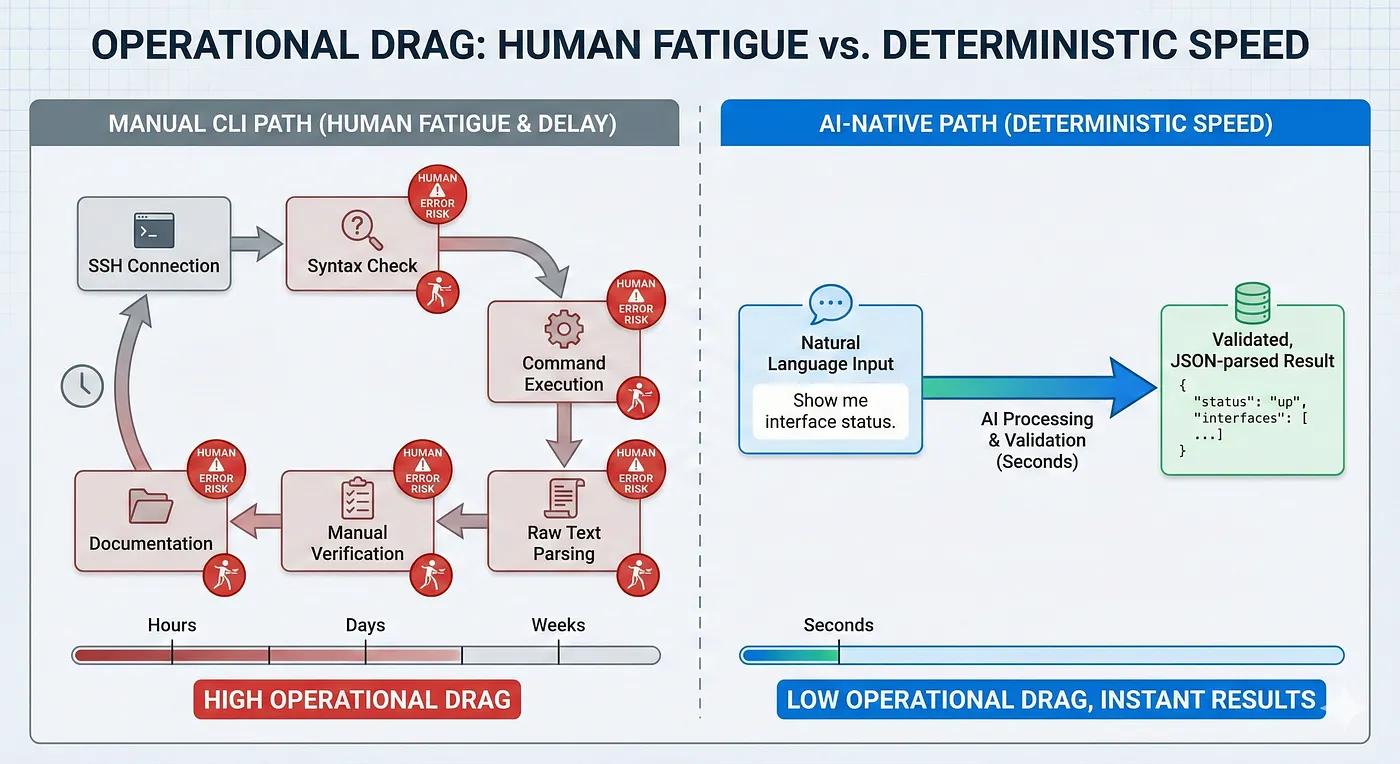
Operational Drag: HUMAN FATIQUE vs DETERMINISTIC SPEED

1. The Cognitive Load and CLI Chaos
Engineers spend a significant portion of their day SSHing into devices, wrestling with syntax, and Waiting for output2. This “CLI chaos” leads to human fatigue, which is a primary driver of misconfigurations. When an engineer is under pressure to reduce Mean Time to Resolution (MTTR), the risk of “fat-finger” errors increases exponentially.
2. The Scaling Failure of Standard Scripting
While Python and Ansible have helped Click here automate repetitive tasks, they are often rigid and lack the ability to handle the nuance of natural language queries or complex troubleshooting workflows. Traditional NetOps is time-intensive because engineers still waste minutes on repetitive queries like “show logging” or simple configuration changes.
3. The Quantitative Drag
The operational drag is measurable. Industry data, including insights from the Harvard Business Review, suggests that AI has the potential to cut repetitive tasks by as much as 80%. Organizations that stick to manual processes are essentially accepting a 4x to 5x slower resolution cycle compared to what is possible with intelligent automation.
Policy-Driven AI Agents vs. Free-Form Automation
The industry’s hesitation toward AI in networking is often rooted in safety. A “free-form” LLM allowed to execute commands directly on a core switch is a recipe for disaster. To make AI-native NetOps inevitable, we must pivot from “untrusted executors” to Policy-Driven AI Agents.
The “Think Before Acting” Paradigm
The architectural shift involves using an intelligent ReAct (Reason + Act) agent. Unlike a basic chatbot, this agent thinks before acting by checking allowed command sets and parsing natural language to map it to actual, safe CLI commands.
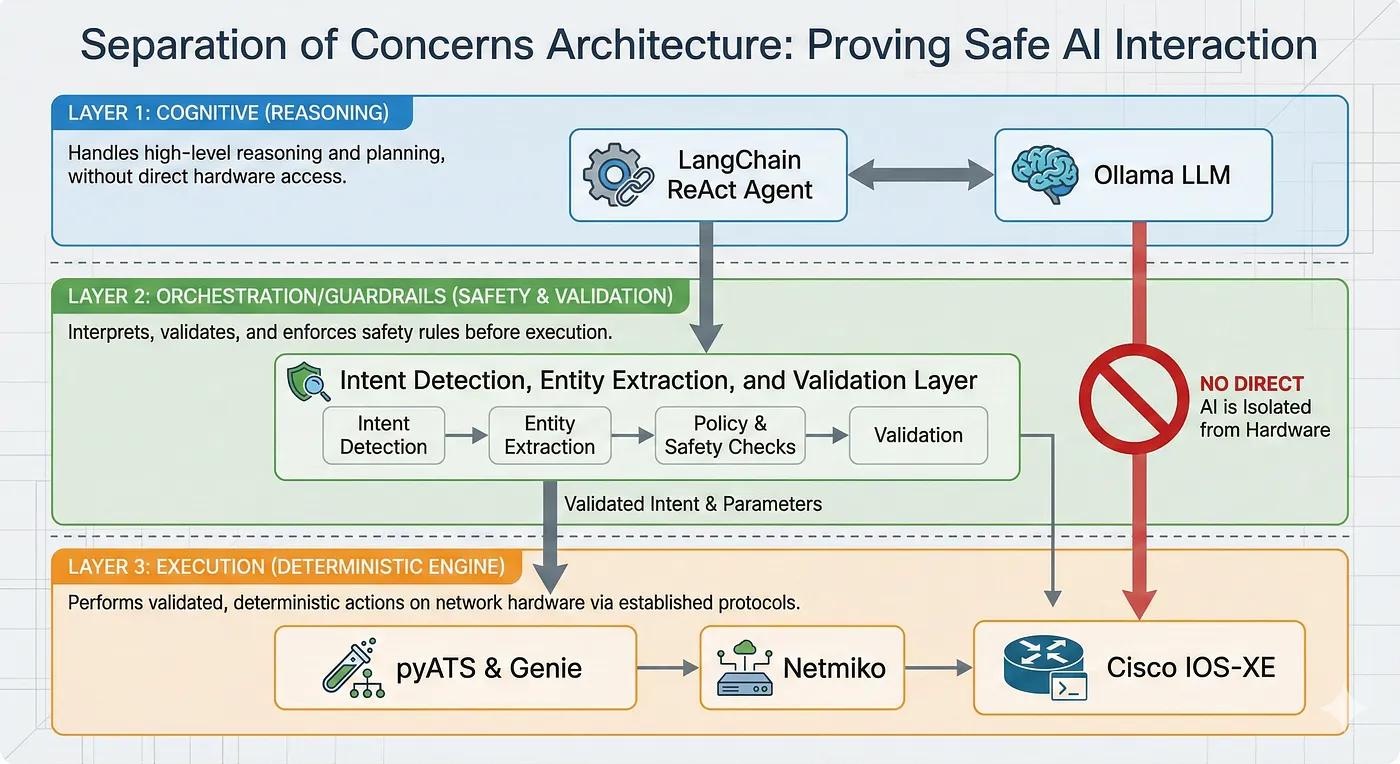
Separations of Concern Architecture: Proving Safe AI Interaction

Deterministic First, AI Second
The philosophy of a production-safe Network AI Agent is built on four core design principles:
Deterministic First: AI is never trusted for the actual execution of commands.
Planner-Driven Execution: Nothing executes unless a valid, predefined plan exists.
Separation of Concerns: The system separates intent detection from execution and validation from configuration .
UI Contract Stability: The interaction remains consistent, even as the underlying AI models evolve.
By enforcing these guardrails, we create an environment where the AI handles the reasoning and planning, but the actual execution is performed by deterministic tools.
Implementing the Network AI Agent
The transition to AI-native ops manifests as a controlled, production-safe automation layer built on top of traditional Cisco CLI devices. This system converts natural-language user queries into deterministic network actions.
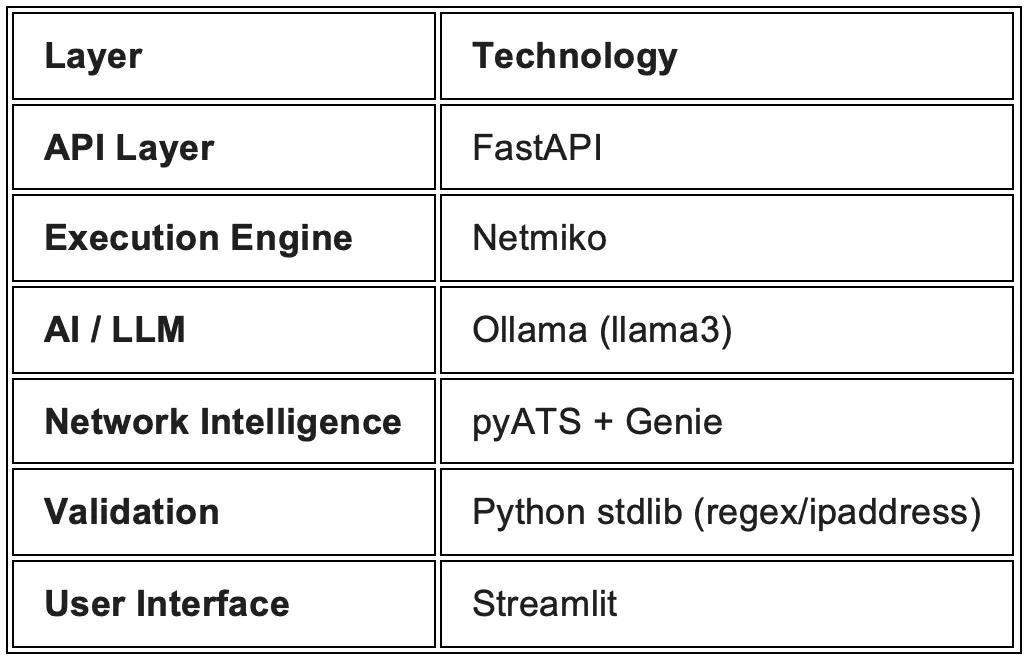
The Technical Stack
To achieve this, the architecture utilizes a multi-layered stack designed for both intelligence and precision:
Separations of Concern Architecture: Proving Safe AI Interaction

The Request Lifecycle: From Intent to Execution
Deterministic Network Task Flow: Logic-based Processing
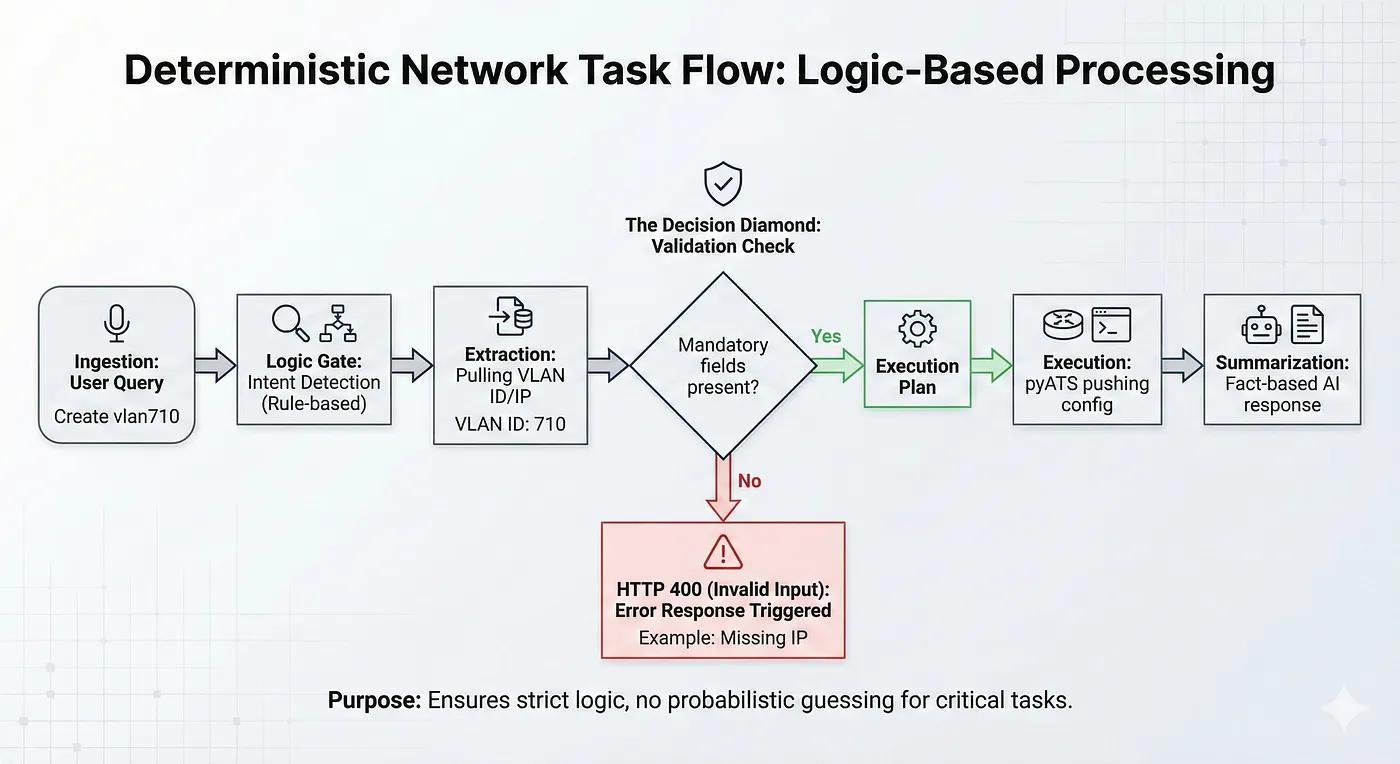
Every query follows a strict lifecycle to ensure safety and accuracy:
Ingestion: The user provides a query, such as “What’s the status of all interfaces?”.
Intent Detection: This is rule-based, not AI-based. It categorizes the request into intents like INTERFACE_LIST or CREATE_VLAN_INTERFACE. This avoids hallucinations.
Entity Extraction: Reusable extractors pull the specific data needed (VLAN ID, IP address, Subnet mask) without mutating any state.
Execution Plan Generation: The planner outputs a deterministic set of steps (e.g., validate, then config, then show).
Validation Layer: This is a critical safety gate. Without validation, incorrect IPs or partial inputs could corrupt device configurations. Missing inputs result in a 400 error rather than a guess.
Execution & Summarization: SHOW commands are parsed into structured JSON33. To avoid overwhelming the LLM, interfaces are consolidated into “Up,” “Down,” or “Admin Down” groups before the AI provides a final human-readable summary.
Production-Safe Use Cases
Log Analysis: Asking for the “last 250 entries” maps directly to show logging last 250.
Interface Config: “Configure a loopback interface with IP” triggers a multi-line configuration set pushed via pyATS.
Routing Verification: “What’s the current routing config?” executes a show run brief and returns parsed data.

Decision Framework: When to Adopt AI-Driven NetOps
Organizations should not adopt AI just for the sake of the technology. Instead, evaluate your readiness based on the following framework:
Complexity Check: If your NOC team spends more than 40% of their time on repetitive “Read-Only” (SHOW) queries, the efficiency gains of AI-native NetOps will be immediate.
Error Rate Check: If human “fat-finger” errors during configuration changes are a recurring theme in your Post-Incident Reviews (PIRs), the mandatory Validation Layer of an AI agent is a requirement, not a luxury.
Security Posture: Organizations requiring a “Local-First” AI approach to keep topology data within the management network should look toward architectures leveraging local LLM APIs like Ollama.
Automation Maturity: If your current scripts are too brittle to handle vendor-specific CLI variations, moving to a pyATS/Genie-backed AI agent provides the abstraction needed to scale.
AI-native NetOps is not a replacement for the engineer; it is a replacement for the engineering drudgery. By empowering NOC teams to interact with the network like chatting with an expert, we reduce resolution times from minutes to seconds and eliminate the syntax barriers of the past.
Experience the Future of NetOps First-hand
Theory is one thing — seeing AI orchestrate a live production network is another.
We are inviting Network Architects, CTOs, and NOC Leads to a private, 30-minute deep-dive demo where we will show you:
The Agent in Action: Watch our ReAct agent parse natural language into complex Cisco configurations in real-time.
Safety Protocols: See exactly how our validation layer prevents “fat-finger” errors before they reach the device.
Private AI Implementation: Learn how we deploy local-first models like Llama3 using Ollama to keep your network data secure.
Don’t just automate — transform. Let’s explore how Ticvic can empower your team today.
Related Blogs
How AI & ML Is Transforming The Farming Industry?
The farming industry is poised for a remarkable transformation as it embraces the best technologies available. From precision agriculture and resource optimization to sustainable practices and data-driven decision-making, these technologies have the potential to revolutionize traditional farming methods. By leveraging innovation, farmers can unlock a multitude of benefits, including increased productivity, optimized resource management, enhanced sustainability, and data-driven insights.
Evolution Of Testing From Manual To Automation
Testing is a crucial process in software development that involves evaluating the quality, functionality, and performance of a software system. It is performed to identify defects, errors, or issues and ensure that the software meets the desired requirements and performs as expected.
Cybersecurity - How To Manage Your Digital Identity?
In the wild, wild west of the digital frontier, wrangling your business’s digital identity is like taming a band of unpredictable cyber outlaws. Picture yourself as the digital sheriff; your mission is to maintain law and order in this vast online town.
Create Virtual Machines Using Microsoft Azure, Google Cloud, Oracle Cloud And AWS
In today’s cloud computing, virtual machines are gaining importance since they provide enterprises of all sizes with flexibility, scalability, and affordability. Several well-known cloud service providers stand out for their robust architecture and extensive selection of choices for creating virtual machines.
Industrial IoT - How Car Manufacturers Use IoT In Their Assembly Lines?
IIoT in the automotive world means connecting every component and device, turning them into data sources that communicate in real-time. Sensors embedded in machines monitor their health, while smart devices oversee quality control. The result is a seamless blend of human expertise and machine precision.
Is Outsourcing A Viable Option In 2023?
Outsourcing is a strategic business practice in which organizations delegate specific tasks, functions, or processes to external third-party service providers rather than handling them in-house. This approach offers numerous advantages, including cost savings, access to specialized skills, and increased operational efficiency.
Agile IT Product Development
Agile IT Product Development has become a buzzword in the software development industry in recent years, as businesses strive to keep up with the fast pace of technological advancements and changing market demands. In essence, Agile is a methodology that emphasizes iterative and collaborative development, continuous improvement, and customer feedback.
Flutter 2023 And Beyond
In 2023, Flutter stands at the forefront of the mobile app development landscape, continuing its remarkable journey of growth and innovation. This open-source framework, developed by Google, has evolved from its initial release into a versatile powerhouse, offering an extensive set of tools and capabilities.
MongoDB Lets Developers Say No To Structural Databases.
When it comes to database systems, developers have a lot of options to choose from. There are traditional relational database systems, such as MySQL and Microsoft SQL Server, as well as newer NoSQL database systems, such as MongoDB and Cassandra.
Advantages Of Using SDN & SDWAN
The network is the backbone of any business. It is responsible for connecting people and devices, and it enables the flow of information and resources. A well-designed network can be a powerful tool that helps businesses run more efficiently and effectively.
The Future of Networking Is Autonomous — Not Automated
Cloud networking has quietly crossed an invisible threshold.More clouds. More edges. More tunnels. More devices. More telemetry. More failure modes no human can track in real time.
Beyond Hop-by-Hop Path Analysis: The Missing Layer in Modern Network Observability
Hop-by-Hop (HBH) Path Analysis is the missing layer because it reveals the truth about the path, not just the endpoints.
Beyond Hop-by-Hop Path Analysis: The Missing Layer in Modern Network Observability
Hop-by-Hop (HBH) Path Analysis is the missing layer because it reveals the truth about the path, not just the endpoints.
The Future of Networking Is Autonomous — Not Automated
Cloud networking has quietly crossed an invisible threshold.More clouds. More edges. More tunnels. More devices. More telemetry. More failure modes no human can track in real time.
AI in SD-WAN: Beyond Performance Scores and Pretty Dashboards
The Truth about “AI-Powered SD-WAN” — Most of it isn’t AI at all .The Lie: When intelligence becomes decoration
Network Failures Are Not Random: Unmasking the Deterministic Patterns of the “Dark Space” — Part I
If you’ve worked in networking long enough, you’ve heard this sentence hundreds of times. A user complains, a service slows down, or a region disconnects
From Monitoring to Autonomy: Building the Predictive Network — Part II
In Part 1, we debunked the myth that network failures are random. We explored how traditional tools miss the “Invisible Middle Mile” and why Hop-by-Hop (HBH) analysis is the required telemetry layer to see the deterministic patterns behind every outage
Why AI-Native Network Operations Are Inevitable
The networking industry is approaching a critical inflection point. For decades, the Command Line Interface (CLI) has been the primary tool for the network engineer.
Why Traditional CLI-Driven NetOps Is Breaking?
Walk into any modern Network Operations Center and you’ll see the same pattern repeating itself.
How Network AI Agents Think Before They Act? From Automation to AI-Native NetOps.
The conversation around AI in infrastructure has reached a fever pitch, but much of what is being proposed sounds, frankly, dangerous to the seasoned engineer.
Beyond Brittle Scripts: The Rise of AI-Native NetOps
The networking industry is reaching a critical inflection point. For decades, the Command Line Interface (CLI) has been the primary tool for the network engineer, but as infrastructure scales in complexity, manual management is no longer sustainable .
Why the “Decoupled” Agent Model Beats the Monolithic Script.
Traditional automation has been a game-changer, but we are reaching a scaling limit where the network’s complexity outpaces human reasoning.
Why Free-Form AI Has No Place in Network Automation
We built an AI agent that does not autonomously execute network commands by design.
The 5 Forces Reshaping Network Operations in 2026
Over the past decade, enterprise networks have transformed from static infrastructure into dynamic, business-critical platforms.

Let's talk.
Need a Consultation!
Need help in turning your idea into a successful product? Talk to us. We can help you build your product quickly and ensure it can scale infinitely.
Let's talk.