BLOG
03 min read
The 5 Forces Reshaping Network Operations in 2026
Thiyagu Ganesan
Posted: Feb 21, 2026
Table of Contents
Why the NetOps Operating Model Is Undergoing a Structural Shift
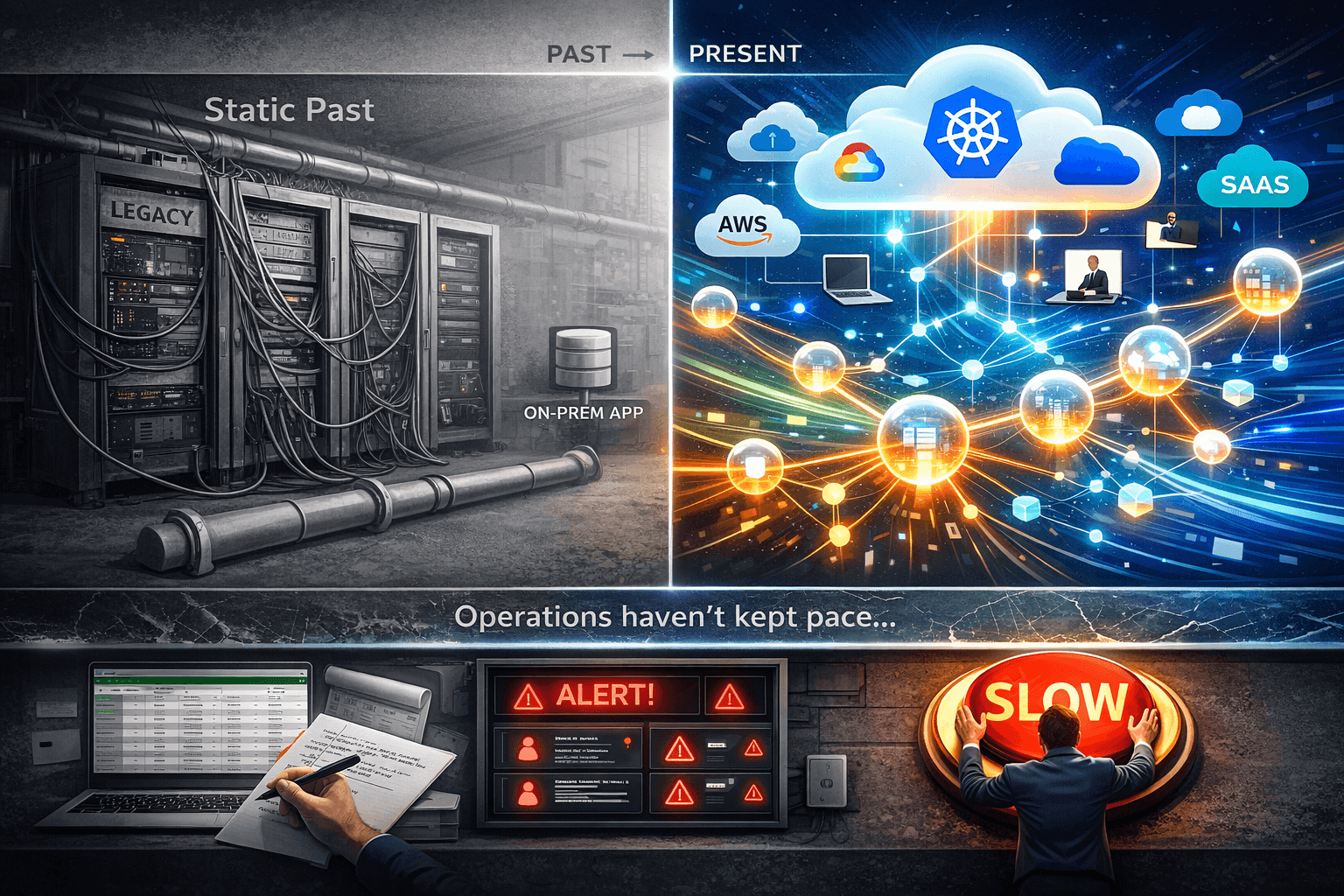
Over the past decade, enterprise networks have transformed from static infrastructure into dynamic, business-critical platforms. They now support cloud-native applications, SaaS ecosystems, hybrid workforces, and distributed digital services.
Yet the way networks are operated has not evolved at the same pace.
Many NetOps teams still rely on:
Manual correlation across multiple tools
CLI-driven troubleshooting
A small number of highly experienced engineers making decisions under pressure
This model worked when environments were smaller and slower moving. In 2026, however, the gap between network complexity and human cognitive capacity has become impossible to ignore.
Across the industry, a structural shift is emerging:
AI-native network operations — where AI assists with reasoning and analysis while deterministic systems execute validated actions.
This shift is not driven by hype. It is being forced by five underlying forces that are reshaping how networks must be operated.
Force 1: Network Complexity Has Outpaced Human Reasoning
Enterprise networks have grown exponentially more complex in the past decade.
A typical enterprise environment now spans:
Multiple public clouds
Private data centers
SaaS platforms
SD-WAN overlays
ISP and peering networks
According to multiple infrastructure studies, the average enterprise now operates hundreds to thousands of network devices, with configurations changing continuously.

The problem is not simply scale — it is interdependency.
An issue in one part of the network can cascade across routing paths, application performance, and cloud connectivity. Diagnosing such issues requires correlating signals from:
Routing tables
Interface states
Telemetry data
Application performance metrics
Security policies
Traditionally, this correlation happens inside the engineer’s head.
But human reasoning does not scale linearly with system complexity.
As environments grow, NetOps teams spend increasing time on:
Investigative work
Configuration analysis
Manual validation
This is where AI begins to add value — not by replacing engineers, but by assisting with large-scale reasoning across signals.
Force 2: MTTR Is Still Dominated by Manual Correlation
Despite decades of automation investment, Mean Time to Resolution (MTTR) remains heavily influenced by human investigation.
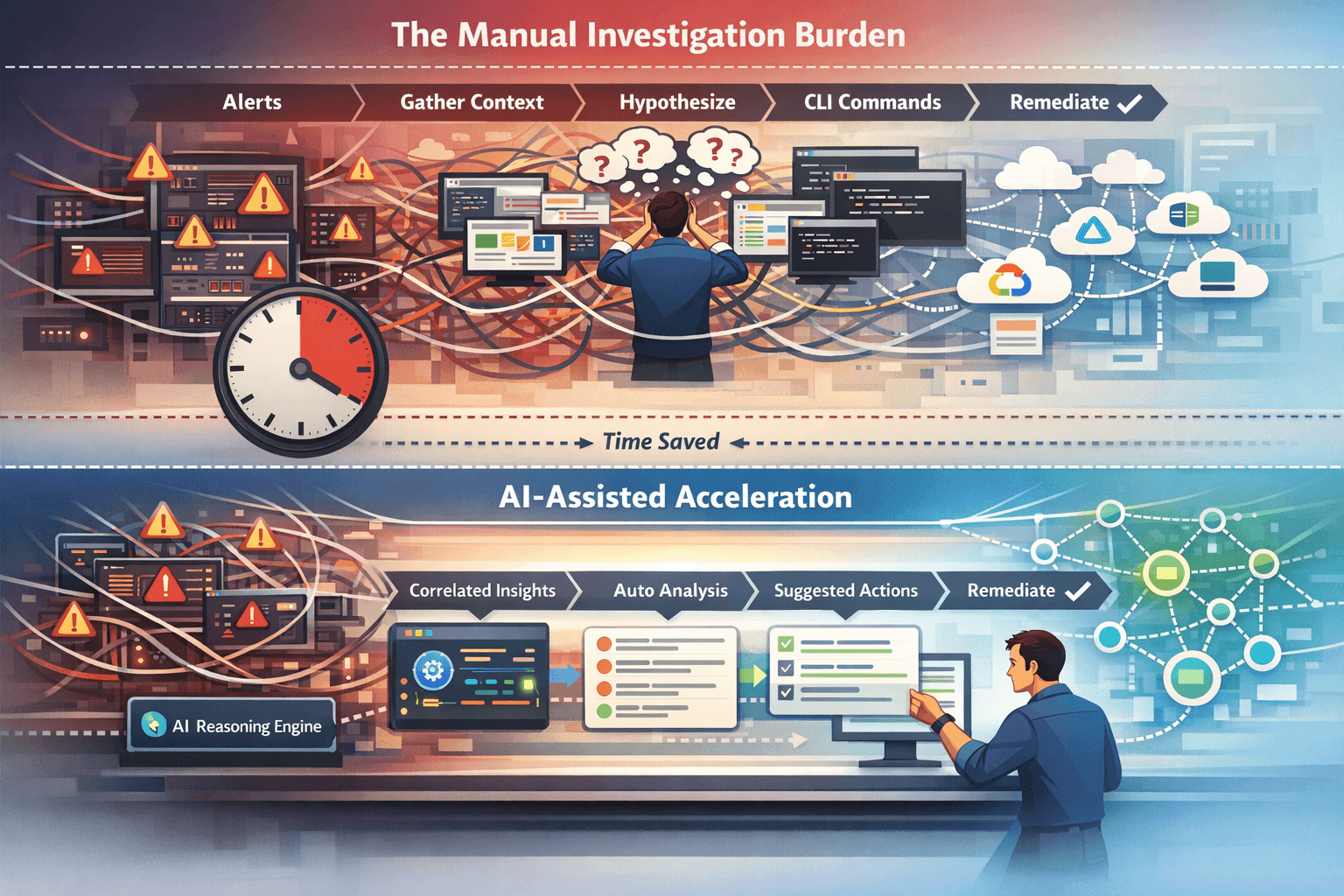
Most incident timelines follow a familiar pattern:
Alerts trigger from monitoring systems
Engineers gather context from multiple tools
Hypotheses are formed about root causes
CLI commands are executed to validate assumptions
Remediation actions are applied
In many cases, the actual fix takes minutes. The majority of time is spent figuring out what happened.
This investigative burden increases dramatically as networks span:
On-prem infrastructure
Multiple cloud providers
Third-party SaaS services
As a result, operational efficiency often depends on the availability of senior engineers who can rapidly interpret signals.

AI-assisted reasoning can dramatically shorten this process by:
Aggregating signals across systems
Identifying likely causal relationships
Generating structured investigation paths
This reduces the cognitive burden on engineers while accelerating decision-making.
Force 3: Talent Scarcity and On-Call Fatigue
Another pressure shaping NetOps in 2026 is the growing scarcity of experienced network engineers.
Senior engineers often carry disproportionate operational responsibility. They are the individuals who understand:
Network topology nuances
Historical configuration decisions
Hidden dependencies between systems
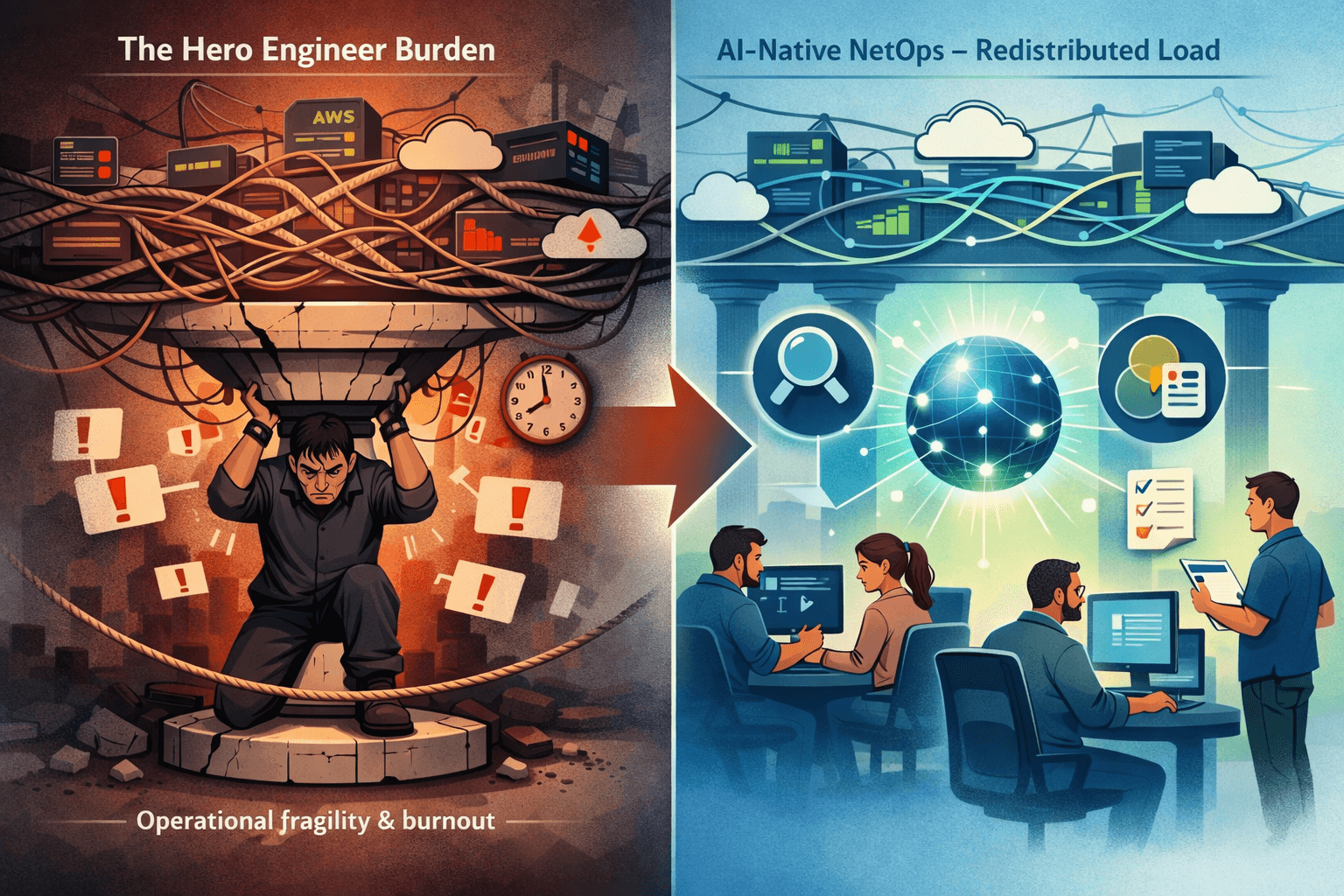
In many organizations, incident resolution relies heavily on these “hero engineers.
This creates two risks:
1.Operational fragility — if key individuals are unavailable
2.Burnout — from constant on-call responsibilities
Industry surveys consistently show that operational fatigue contributes significantly to human error in infrastructure environments.

AI-native NetOps aims to redistribute this cognitive load.
Instead of engineers constantly performing signal correlation and validation, AI systems can assist with:
Investigative reasoning
Pattern recognition
Plan generation
Engineers remain in control, but the system absorbs much of the repetitive analysis.
Force 4: Automation Without Context Has Reached Its Limits
Over the past decade, network automation has evolved significantly through tools such as:
Infrastructure-as-Code frameworks
Configuration management systems
Script-driven workflows
These tools have improved consistency and reduced manual configuration errors. However, they still operate within a deterministic model: execute predefined tasks when triggered.
The limitation emerges when context changes.
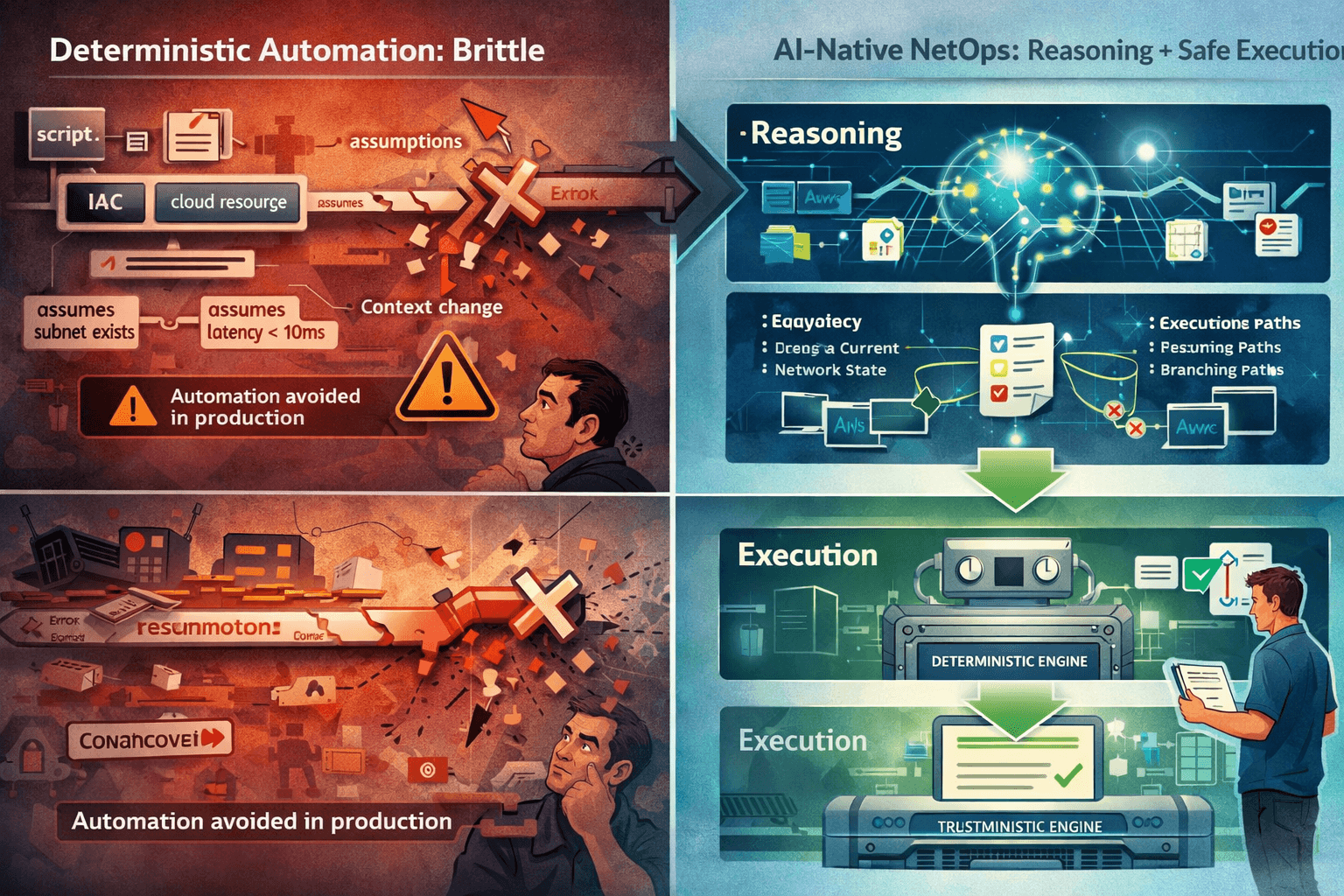
Automation scripts assume certain conditions are true. When those assumptions break, automation can fail — sometimes catastrophically.
This has led many organizations to treat automation cautiously in production environments.
AI-native NetOps introduces a different approach.
Instead of blindly executing scripts, an AI agent can:
Interpret intent
Evaluate the current network state
Compare potential execution paths
Generate safe plans before execution

The key architectural principle is separating reasoning from execution.
AI performs the reasoning step.
Deterministic systems perform the execution.
This preserves safety while improving adaptability.
Force 5: Reliability Expectations Are Higher Than Ever
The final force reshaping network operations is the growing dependence of businesses on digital infrastructure.
Networks now directly support:
Customer-facing applications
Financial transactions
Real-time collaboration systems
Global service delivery
As a result, downtime carries significantly higher costs.
Research from multiple IT reliability studies shows that even small outages can cost organizations tens or hundreds of thousands of dollars per hour in lost productivity and revenue.
This has elevated network reliability from a technical concern to an executive priority.
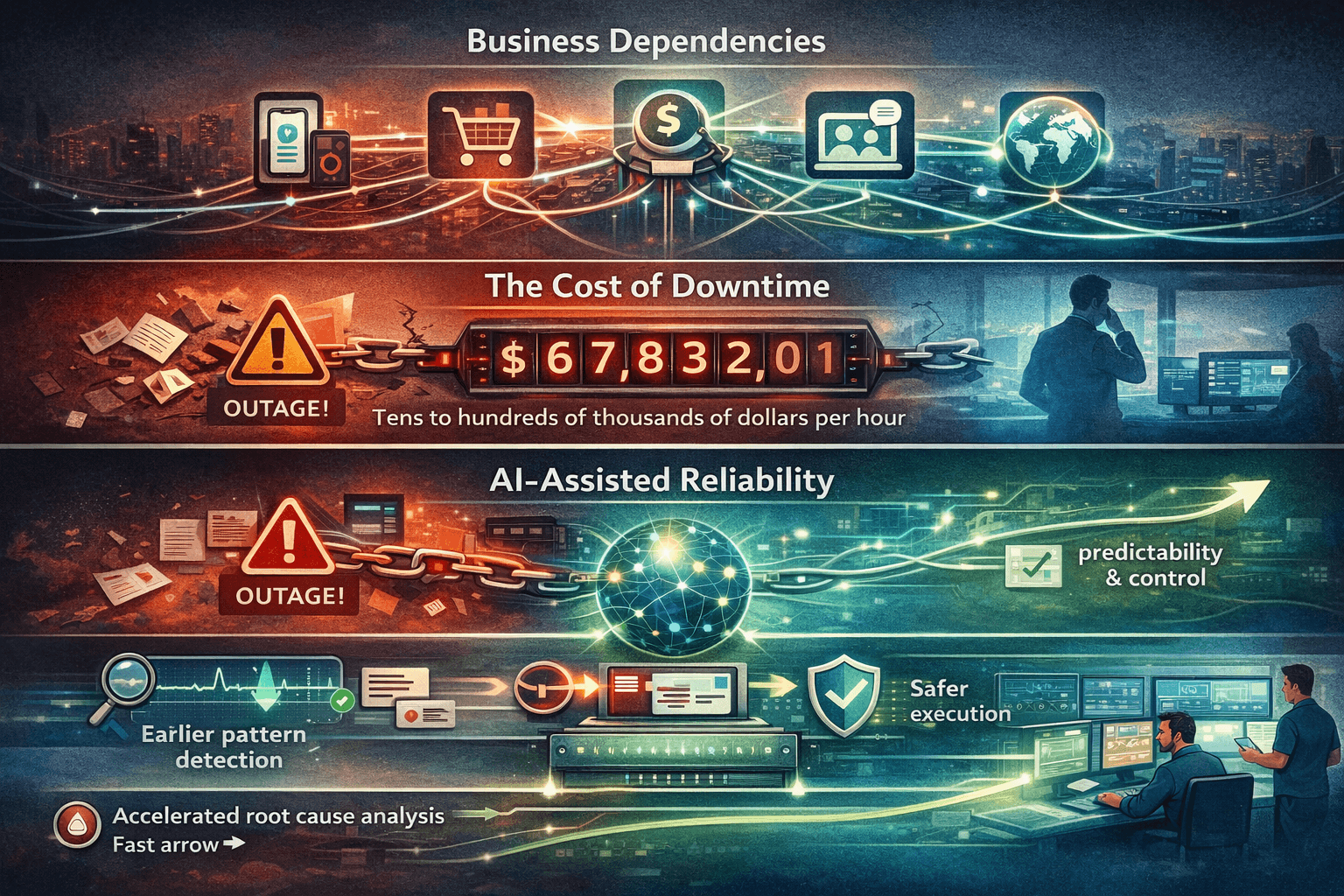
However, improving reliability using purely manual operational models becomes increasingly difficult as environments scale.

AI-assisted operations can improve reliability by:
Detecting patterns earlier
Accelerating root cause analysis
Ensuring safer execution through validation layers
This creates a more predictable and controlled operational environment.
The Emergence of AI-Native NetOps
These five forces collectively point toward a new operating model.
AI-native NetOps does not attempt to replace engineers or remove human oversight.
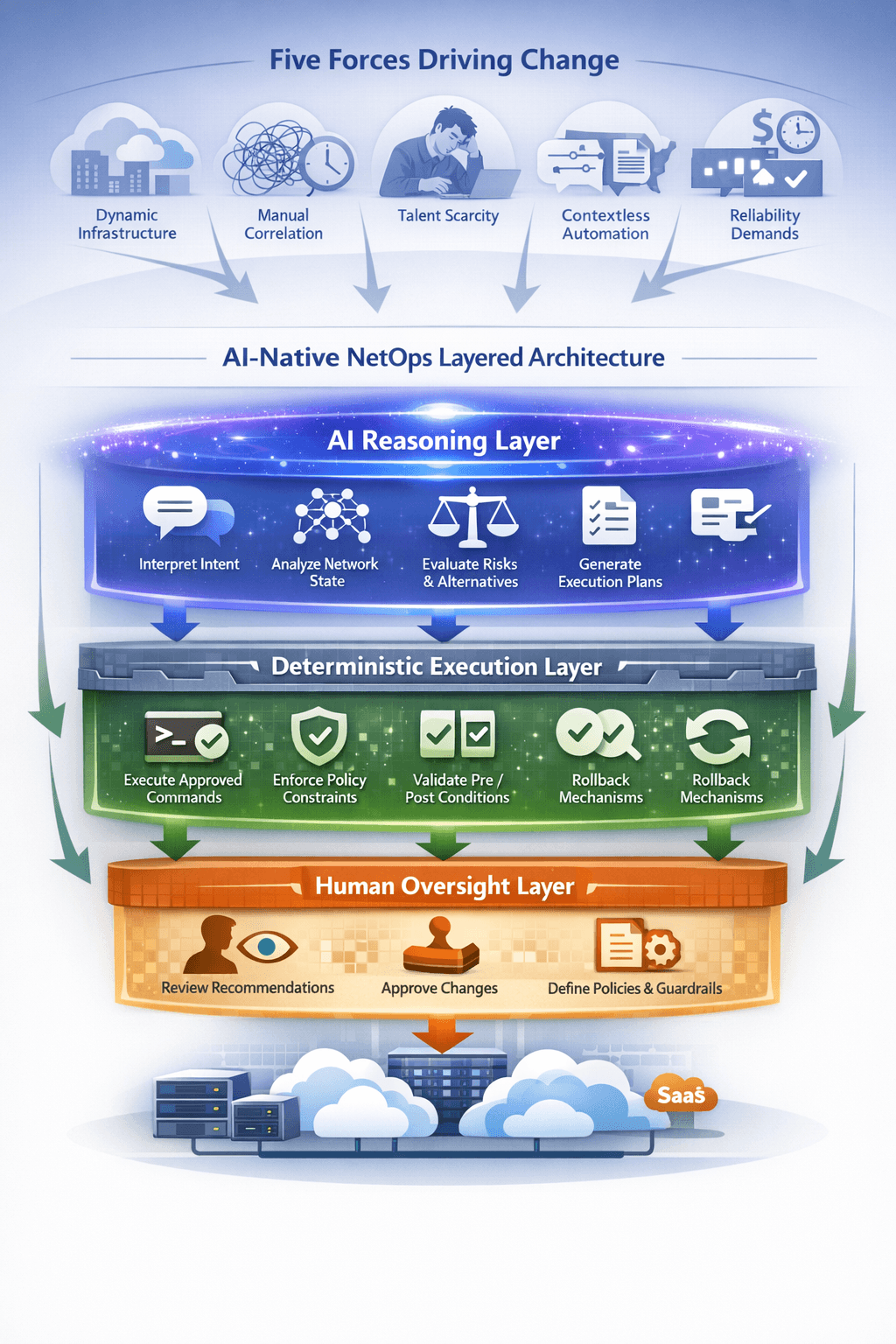
Instead, it introduces a layered architecture:
1. AI Reasoning Layer
Interprets operator intent
Analyzes network state
Evaluates risks and alternatives
Generates execution plans
2. Deterministic Execution Layer
Executes only approved commands
Enforces policy constraints
Validates pre- and post-conditions
Supports rollback mechanisms
3. Human Oversight Layer
Reviews recommendations
Approves changes when required
Defines policies and guardrails
This separation ensures that AI enhances reasoning while execution remains controlled and predictable.

A Structural Shift, Not a Tool Upgrade
The forces reshaping NetOps in 2026 are not temporary trends. They represent structural changes in how networks are built and used.
Complexity continues to grow
Human expertise remains scarce
Reliability expectations continue rising
Under these conditions, simply adding more tools or scripts is no longer sufficient.
What is changing is the operating model itself.
Engineers are moving away from acting primarily as:
Command-line operators
Signal correlators
Emergency responders
Instead, they increasingly function as:
System designers
Policy architects
Supervisors of intelligent operational systems
AI-native NetOps does not remove humans from the loop.
It allows humans to focus on judgment, architecture, and strategy, while intelligent systems assist with large-scale reasoning.
A Practical Example: The Ticvic’s Network AI Agent
At Ticvic, we have been applying these principles in the design of the Ticvic Network AI Agent — a system built to assist network engineers with reasoning, diagnostics, and controlled execution.
The agent is designed around the same architectural separation described above:
AI interprets intent and analyzes network state
Execution is performed through deterministic command templates
Policy constraints and validation guardrails ensure safe operation
The goal is not autonomous networks, but AI-assisted NetOps where engineers remain firmly in control while the system handles large-scale reasoning and correlation.
See the Model in Action
If you're interested in how AI reasoning, validation guardrails, and deterministic execution work together in practice, we regularly run a 30-minute live walkthrough of the Ticvic Network AI Agent architecture and workflows.
You can schedule a session here:
Click here for schedule a session here:
The session focuses on the technical architecture and operational model, not a sales presentation.
Related Blogs
How AI & ML Is Transforming The Farming Industry?
The farming industry is poised for a remarkable transformation as it embraces the best technologies available. From precision agriculture and resource optimization to sustainable practices and data-driven decision-making, these technologies have the potential to revolutionize traditional farming methods. By leveraging innovation, farmers can unlock a multitude of benefits, including increased productivity, optimized resource management, enhanced sustainability, and data-driven insights.
Evolution Of Testing From Manual To Automation
Testing is a crucial process in software development that involves evaluating the quality, functionality, and performance of a software system. It is performed to identify defects, errors, or issues and ensure that the software meets the desired requirements and performs as expected.
Cybersecurity - How To Manage Your Digital Identity?
In the wild, wild west of the digital frontier, wrangling your business’s digital identity is like taming a band of unpredictable cyber outlaws. Picture yourself as the digital sheriff; your mission is to maintain law and order in this vast online town.
Create Virtual Machines Using Microsoft Azure, Google Cloud, Oracle Cloud And AWS
In today’s cloud computing, virtual machines are gaining importance since they provide enterprises of all sizes with flexibility, scalability, and affordability. Several well-known cloud service providers stand out for their robust architecture and extensive selection of choices for creating virtual machines.
Industrial IoT - How Car Manufacturers Use IoT In Their Assembly Lines?
IIoT in the automotive world means connecting every component and device, turning them into data sources that communicate in real-time. Sensors embedded in machines monitor their health, while smart devices oversee quality control. The result is a seamless blend of human expertise and machine precision.
Is Outsourcing A Viable Option In 2023?
Outsourcing is a strategic business practice in which organizations delegate specific tasks, functions, or processes to external third-party service providers rather than handling them in-house. This approach offers numerous advantages, including cost savings, access to specialized skills, and increased operational efficiency.
Agile IT Product Development
Agile IT Product Development has become a buzzword in the software development industry in recent years, as businesses strive to keep up with the fast pace of technological advancements and changing market demands. In essence, Agile is a methodology that emphasizes iterative and collaborative development, continuous improvement, and customer feedback.
Flutter 2023 And Beyond
In 2023, Flutter stands at the forefront of the mobile app development landscape, continuing its remarkable journey of growth and innovation. This open-source framework, developed by Google, has evolved from its initial release into a versatile powerhouse, offering an extensive set of tools and capabilities.
MongoDB Lets Developers Say No To Structural Databases.
When it comes to database systems, developers have a lot of options to choose from. There are traditional relational database systems, such as MySQL and Microsoft SQL Server, as well as newer NoSQL database systems, such as MongoDB and Cassandra.
Advantages Of Using SDN & SDWAN
The network is the backbone of any business. It is responsible for connecting people and devices, and it enables the flow of information and resources. A well-designed network can be a powerful tool that helps businesses run more efficiently and effectively.
The Future of Networking Is Autonomous — Not Automated
Cloud networking has quietly crossed an invisible threshold.More clouds. More edges. More tunnels. More devices. More telemetry. More failure modes no human can track in real time.
Beyond Hop-by-Hop Path Analysis: The Missing Layer in Modern Network Observability
Hop-by-Hop (HBH) Path Analysis is the missing layer because it reveals the truth about the path, not just the endpoints.
Beyond Hop-by-Hop Path Analysis: The Missing Layer in Modern Network Observability
Hop-by-Hop (HBH) Path Analysis is the missing layer because it reveals the truth about the path, not just the endpoints.
The Future of Networking Is Autonomous — Not Automated
Cloud networking has quietly crossed an invisible threshold.More clouds. More edges. More tunnels. More devices. More telemetry. More failure modes no human can track in real time.
AI in SD-WAN: Beyond Performance Scores and Pretty Dashboards
The Truth about “AI-Powered SD-WAN” — Most of it isn’t AI at all .The Lie: When intelligence becomes decoration
Network Failures Are Not Random: Unmasking the Deterministic Patterns of the “Dark Space” — Part I
If you’ve worked in networking long enough, you’ve heard this sentence hundreds of times. A user complains, a service slows down, or a region disconnects
From Monitoring to Autonomy: Building the Predictive Network — Part II
In Part 1, we debunked the myth that network failures are random. We explored how traditional tools miss the “Invisible Middle Mile” and why Hop-by-Hop (HBH) analysis is the required telemetry layer to see the deterministic patterns behind every outage
Why AI-Native Network Operations Are Inevitable
The networking industry is approaching a critical inflection point. For decades, the Command Line Interface (CLI) has been the primary tool for the network engineer.
Why Traditional CLI-Driven NetOps Is Breaking?
Walk into any modern Network Operations Center and you’ll see the same pattern repeating itself.
How Network AI Agents Think Before They Act? From Automation to AI-Native NetOps.
The conversation around AI in infrastructure has reached a fever pitch, but much of what is being proposed sounds, frankly, dangerous to the seasoned engineer.
Beyond Brittle Scripts: The Rise of AI-Native NetOps
The networking industry is reaching a critical inflection point. For decades, the Command Line Interface (CLI) has been the primary tool for the network engineer, but as infrastructure scales in complexity, manual management is no longer sustainable .
Why the “Decoupled” Agent Model Beats the Monolithic Script.
Traditional automation has been a game-changer, but we are reaching a scaling limit where the network’s complexity outpaces human reasoning.
Why Free-Form AI Has No Place in Network Automation
We built an AI agent that does not autonomously execute network commands by design.
The 5 Forces Reshaping Network Operations in 2026
Over the past decade, enterprise networks have transformed from static infrastructure into dynamic, business-critical platforms.

Let's talk.
Need a Consultation!
Need help in turning your idea into a successful product? Talk to us. We can help you build your product quickly and ensure it can scale infinitely.
Let's talk.