BLOG
03 mins read
Why Traditional CLI-Driven NetOps Is Breaking?
Thiyagu Ganesan
Posted: Jan 21, 2026
Table of Contents
The Operational Reality Modern NetOps Can No Longer Ignore
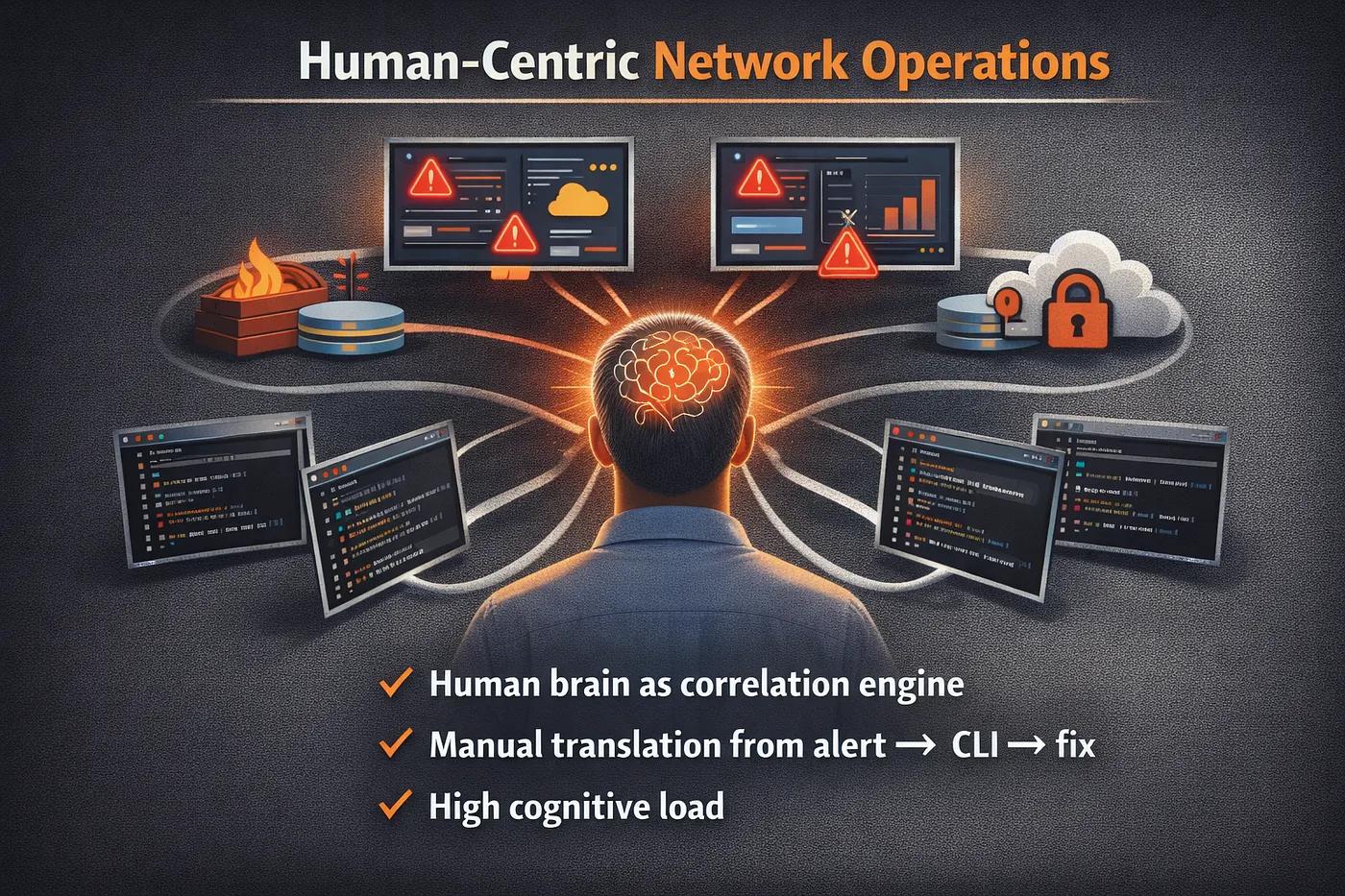
Walk into any modern Network Operations Center and you’ll see the same pattern repeating itself.
Multiple screens
Multiple dashboards
Multiple vendors
One exhausted engineer jumping between them.
The network, however, has fundamentally changed.
Today’s enterprise networks span:
- Multiple public clouds
- SaaS backbones
- SD-WAN overlays
- ISP interconnects
- Thousands of dynamic endpoints
Yet the operating model is still human-centric and CLI-driven.

This model assumes humans can:
- Memorize complex CLIs across vendors
- Context-switch instantly
- Correlate multi-domain failures in real time
That assumption no longer holds.
Human Fatigue Is Now a Reliability Risk
On-call rotations tell the real story:
- After 6–8 hours, error probability rises sharply
- Simple mistakes cascade into outages
- Rollbacks are missed or incomplete
Industry data consistently shows:
- ~60–70% of outages involve human error
- MTTR grows linearly with network complexity
- Senior engineers spend 40%+ time on repetitive ops
This is not a skills gap. “It’s a cognitive scalability problem.”
Why “More Tools” Didn’t Help
Most organizations responded by adding:
- More dashboards
- More alerts
- More scripts
Instead of reducing load, this increased mental overhead.
Engineers now manage:
- Tool sprawl
- Alert fatigue
- Partial visibility
- Conflicting signals
The network outpaced the human brain.
Why Scripting and Automation Hit a Wall
To escape CLI overload, teams turned to automation:
- Shell scripts
- Ansible playbooks
- Custom orchestration pipelines
Initially, this worked. Until it didn’t.
The Fundamental Limitation of Scripts
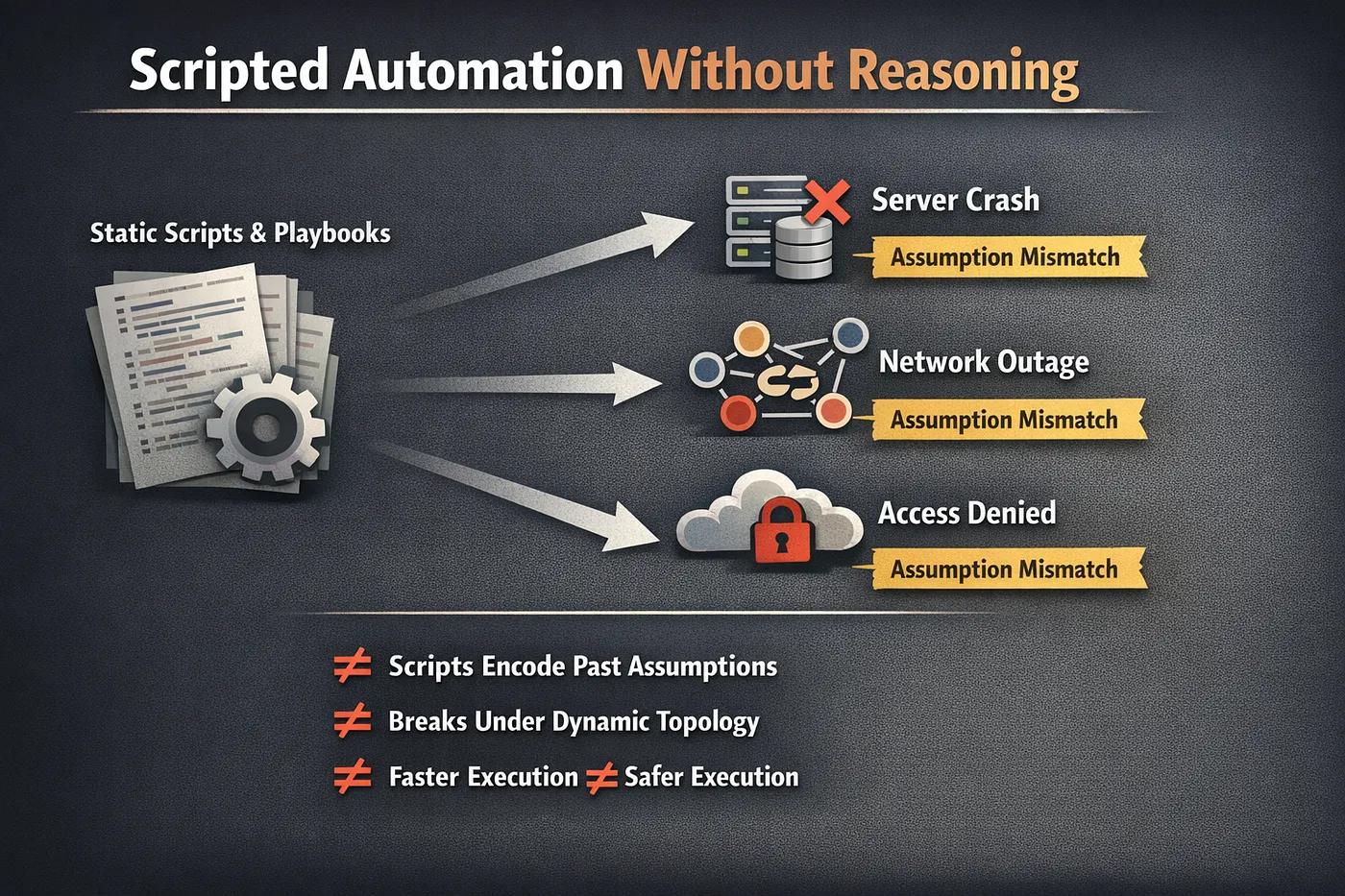
“Scripts encode decisions made in the past.”
They assume:
- Static topology
- Predictable failure modes
- Known edge cases.
Reality is different:
- Cloud routing changes dynamically
- ISPs reroute unpredictably
- Failures rarely match playbooks
When scripts break:
- Debugging them during incidents is slower than CLI
- Engineers disable automation “just this once”
- Trust erodes rapidly
Automation without reasoning simply moves human error earlier in the chain — often with a larger blast radius.
The Core Insight
The problem isn’t automation.
The problem is “automation without understanding”.
Modern NetOps needs systems that can:
- Interpret intent
- Reason about context
- Adapt plans dynamically
- Still execute safely
This is where AI-native operations begin.
The Shift That Makes AI-Native NetOps Inevitable
AI-native NetOps is not about replacing engineers.
It’s about “changing where human cognition is applied.”
Instead of humans:
- Manually reasoning under pressure
They:
- Supervise systems that reason continuously
The CLI is no longer the “brain” of the network.
It becomes an execution interface — not the decision-maker.
That shift is inevitable because:
- Networks grow faster than human reasoning capacity
- Operational risk compounds with complexity
- Fatigue is now a first-order reliability concern
- Manually reasoning under pressure
The question is no longer *if* this shift happens —
only *how safely* it’s implemented.
The CLI is not dead
But relying on it as the primary operational control plane is no longer sustainable.
AI-native NetOps emerges not from hype,
but from “operational necessity.”
See How This Evolves in Practice
I’d be glad to walk you through how we architect AI systems that reason “before” they act, without compromising safety.
If you’re curious to explore the validation and control mechanisms behind this approach, you can Reach out to our engineering team Book a 30-minute Call for technical walkthrough.
Related Blogs
How AI & ML Is Transforming The Farming Industry?
The farming industry is poised for a remarkable transformation as it embraces the best technologies available. From precision agriculture and resource optimization to sustainable practices and data-driven decision-making, these technologies have the potential to revolutionize traditional farming methods. By leveraging innovation, farmers can unlock a multitude of benefits, including increased productivity, optimized resource management, enhanced sustainability, and data-driven insights.
Evolution Of Testing From Manual To Automation
Testing is a crucial process in software development that involves evaluating the quality, functionality, and performance of a software system. It is performed to identify defects, errors, or issues and ensure that the software meets the desired requirements and performs as expected.
Cybersecurity - How To Manage Your Digital Identity?
In the wild, wild west of the digital frontier, wrangling your business’s digital identity is like taming a band of unpredictable cyber outlaws. Picture yourself as the digital sheriff; your mission is to maintain law and order in this vast online town.
Create Virtual Machines Using Microsoft Azure, Google Cloud, Oracle Cloud And AWS
In today’s cloud computing, virtual machines are gaining importance since they provide enterprises of all sizes with flexibility, scalability, and affordability. Several well-known cloud service providers stand out for their robust architecture and extensive selection of choices for creating virtual machines.
Industrial IoT - How Car Manufacturers Use IoT In Their Assembly Lines?
IIoT in the automotive world means connecting every component and device, turning them into data sources that communicate in real-time. Sensors embedded in machines monitor their health, while smart devices oversee quality control. The result is a seamless blend of human expertise and machine precision.
Is Outsourcing A Viable Option In 2023?
Outsourcing is a strategic business practice in which organizations delegate specific tasks, functions, or processes to external third-party service providers rather than handling them in-house. This approach offers numerous advantages, including cost savings, access to specialized skills, and increased operational efficiency.
Agile IT Product Development
Agile IT Product Development has become a buzzword in the software development industry in recent years, as businesses strive to keep up with the fast pace of technological advancements and changing market demands. In essence, Agile is a methodology that emphasizes iterative and collaborative development, continuous improvement, and customer feedback.
Flutter 2023 And Beyond
In 2023, Flutter stands at the forefront of the mobile app development landscape, continuing its remarkable journey of growth and innovation. This open-source framework, developed by Google, has evolved from its initial release into a versatile powerhouse, offering an extensive set of tools and capabilities.
MongoDB Lets Developers Say No To Structural Databases.
When it comes to database systems, developers have a lot of options to choose from. There are traditional relational database systems, such as MySQL and Microsoft SQL Server, as well as newer NoSQL database systems, such as MongoDB and Cassandra.
Advantages Of Using SDN & SDWAN
The network is the backbone of any business. It is responsible for connecting people and devices, and it enables the flow of information and resources. A well-designed network can be a powerful tool that helps businesses run more efficiently and effectively.
The Future of Networking Is Autonomous — Not Automated
Cloud networking has quietly crossed an invisible threshold.More clouds. More edges. More tunnels. More devices. More telemetry. More failure modes no human can track in real time.
Beyond Hop-by-Hop Path Analysis: The Missing Layer in Modern Network Observability
Hop-by-Hop (HBH) Path Analysis is the missing layer because it reveals the truth about the path, not just the endpoints.
Beyond Hop-by-Hop Path Analysis: The Missing Layer in Modern Network Observability
Hop-by-Hop (HBH) Path Analysis is the missing layer because it reveals the truth about the path, not just the endpoints.
The Future of Networking Is Autonomous — Not Automated
Cloud networking has quietly crossed an invisible threshold.More clouds. More edges. More tunnels. More devices. More telemetry. More failure modes no human can track in real time.
AI in SD-WAN: Beyond Performance Scores and Pretty Dashboards
The Truth about “AI-Powered SD-WAN” — Most of it isn’t AI at all .The Lie: When intelligence becomes decoration
Network Failures Are Not Random: Unmasking the Deterministic Patterns of the “Dark Space” — Part I
If you’ve worked in networking long enough, you’ve heard this sentence hundreds of times. A user complains, a service slows down, or a region disconnects
From Monitoring to Autonomy: Building the Predictive Network — Part II
In Part 1, we debunked the myth that network failures are random. We explored how traditional tools miss the “Invisible Middle Mile” and why Hop-by-Hop (HBH) analysis is the required telemetry layer to see the deterministic patterns behind every outage
Why AI-Native Network Operations Are Inevitable
The networking industry is approaching a critical inflection point. For decades, the Command Line Interface (CLI) has been the primary tool for the network engineer.
Why Traditional CLI-Driven NetOps Is Breaking?
Walk into any modern Network Operations Center and you’ll see the same pattern repeating itself.
How Network AI Agents Think Before They Act? From Automation to AI-Native NetOps.
The conversation around AI in infrastructure has reached a fever pitch, but much of what is being proposed sounds, frankly, dangerous to the seasoned engineer.
Beyond Brittle Scripts: The Rise of AI-Native NetOps
The networking industry is reaching a critical inflection point. For decades, the Command Line Interface (CLI) has been the primary tool for the network engineer, but as infrastructure scales in complexity, manual management is no longer sustainable .
Why the “Decoupled” Agent Model Beats the Monolithic Script.
Traditional automation has been a game-changer, but we are reaching a scaling limit where the network’s complexity outpaces human reasoning.
Why Free-Form AI Has No Place in Network Automation
We built an AI agent that does not autonomously execute network commands by design.
The 5 Forces Reshaping Network Operations in 2026
Over the past decade, enterprise networks have transformed from static infrastructure into dynamic, business-critical platforms.

Let's talk.
Need a Consultation!
Need help in turning your idea into a successful product? Talk to us. We can help you build your product quickly and ensure it can scale infinitely.
Let's talk.