BLOG
04 min read
How Network AI Agents Think Before They Act? From Automation to AI-Native NetOps.
Thiyagu Ganesan
Posted: Jan 29, 2026
Table of Contents
Introduction
The conversation around AI in infrastructure has reached a fever pitch, but much of what is being proposed sounds, frankly, dangerous to the seasoned engineer. We’ve heard the pitches: “let the LLM execute CLI directly,” “allow AI to auto-fix outages,” or the most controversial, “remove the human from the loop”. Experienced engineers instinctively push back against these ideas, and they are absolutely right to do so.
The reality is that free-form AI systems are probabilistic and non-deterministic. They are optimized for the nuances of language rather than technical correctness. Letting a system like that directly modify a production network isn’t innovation; it’s operational malpractice. However, rejecting AI entirely means missing a genuine breakthrough in how we manage complex systems.
The Breakthrough: Separating Reasoning from Execution
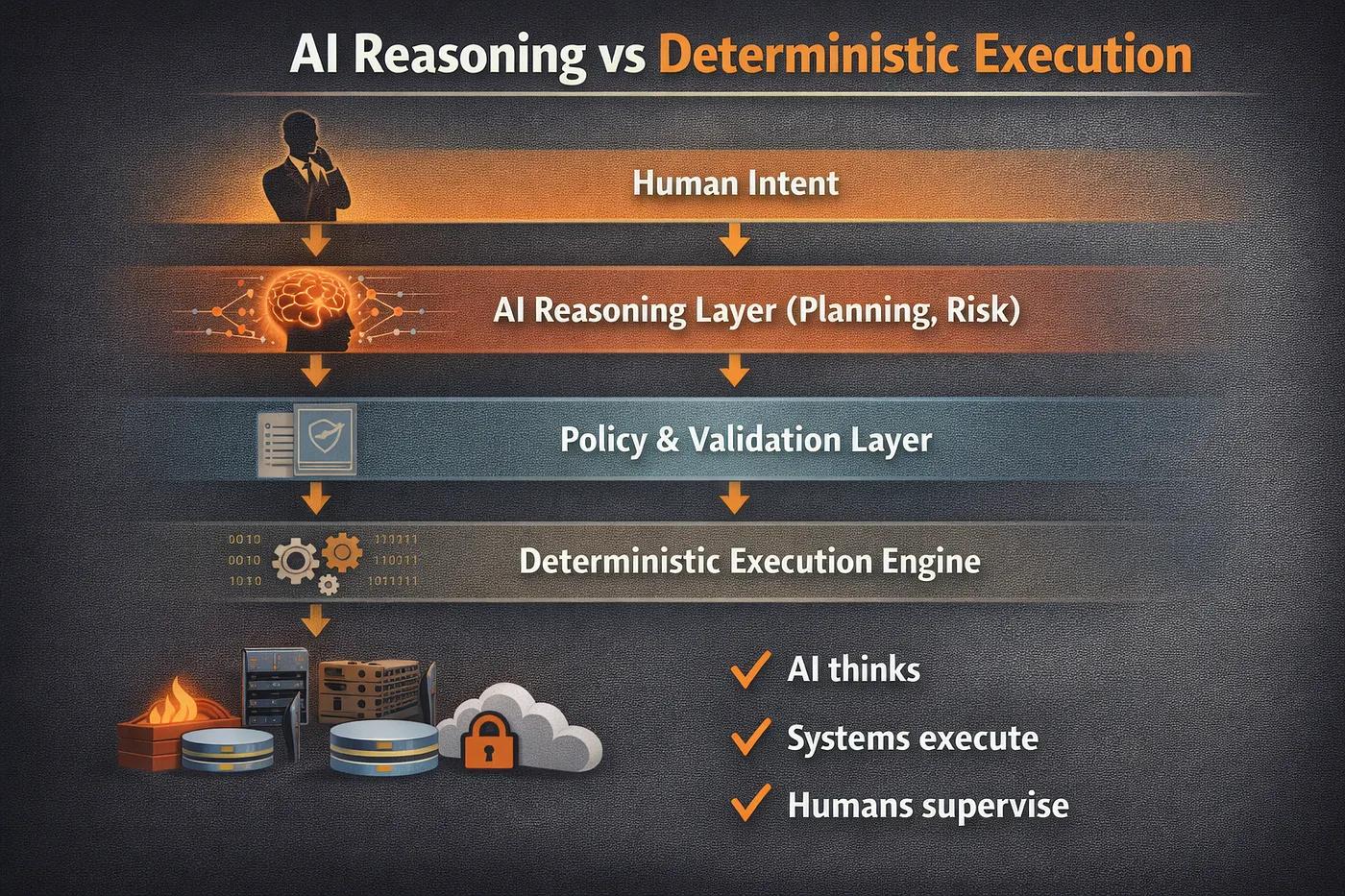
The key to safe AI-native NetOps lies in a single architectural insight: AI should think, systems should execute, and humans should supervise. This requires a clean, non-negotiable separation between two distinct layers.
1. The Reasoning Layer (The AI “Brain”)
This is where the Large Language Model (LLM) actually lives. Because this layer is decoupled from the hardware, it is allowed to be probabilistic and flexible. It is responsible for interpreting human intent, understanding complex topologies, evaluating operational risk, and generating step-by-step plans.
2. The Execution Layer (The Deterministic “Hands”)
Unlike the reasoning layer, this environment is strictly locked down. It never improvises. Instead, it uses pre-approved command templates, enforces rigid policy constraints, and validates both pre- and post-conditions. It also provides the critical ability to support rollbacks if a change doesn’t meet health checks.
Risk explodes when these two layers are collapsed into one. AI-native NetOps works specifically because they remain decoupled.
A diagram illustrating the decoupling of AI reasoning from deterministic execution.

What is a Network AI Agent?
A Network AI Agent is far more than a chatbot; it is a policy-driven operational control plane. Every movement within the system is designed to be observable and auditable.
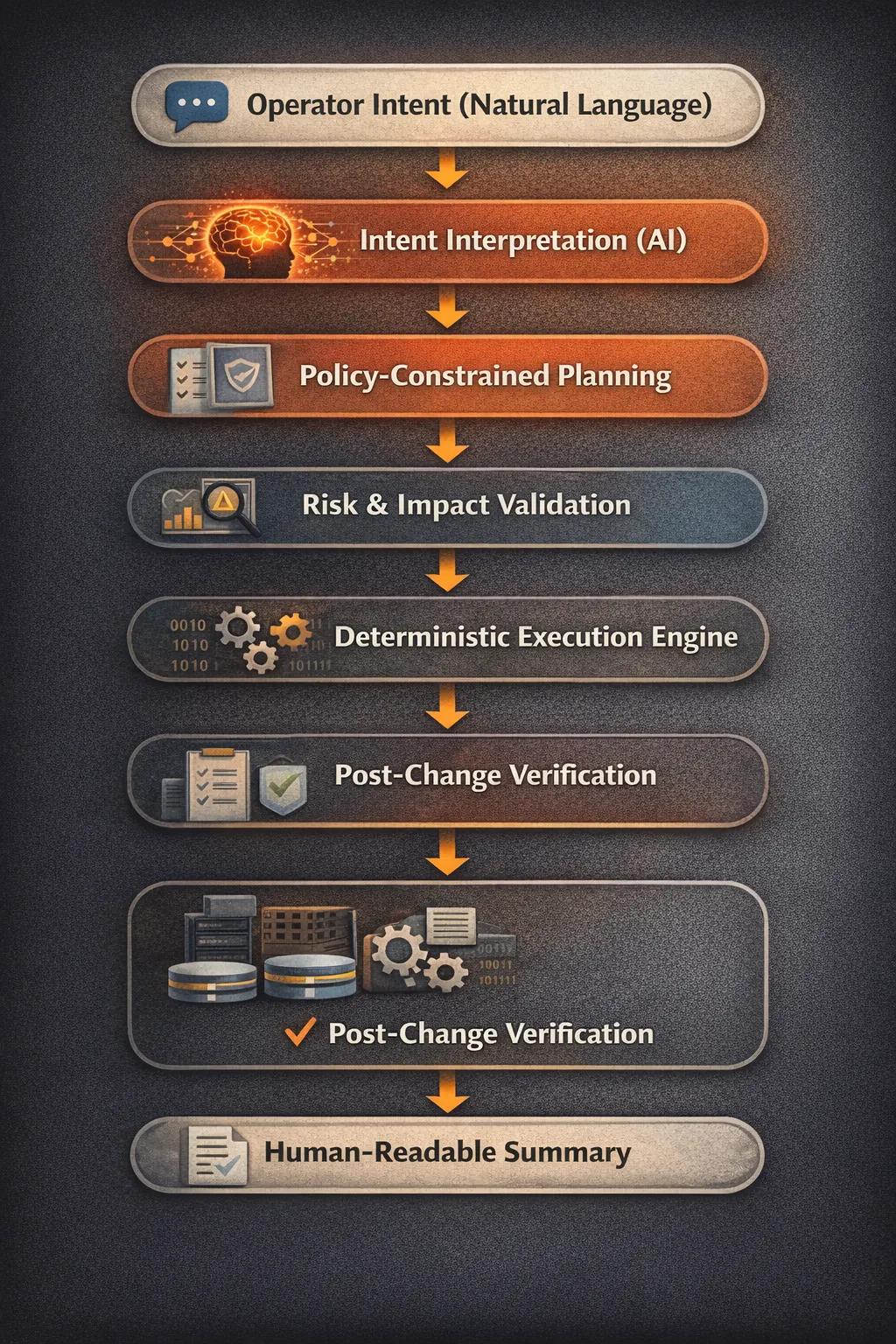
A detailed flow diagram of the Network AI Agent operational lifecycle

To understand how this looks in practice, imagine an operator needing to shift traffic away from a specific ISP due to packet loss at a branch office. In a traditional setup, this involves manual correlation and syntax translation. With an AI Agent, the process is far more rigorous:
Identification: The agent identifies the affected paths.
Evaluation: It evaluates alternate routes and checks them against existing policy constraints.
Planning: It generates a deterministic, step-by-step plan.
Authorisation: It requests human approval before moving forward.
Execution: It executes only using approved CLI templates.
Verification: It verifies convergence and overall network health before summarising the outcome.
At no point in this lifecycle does the AI invent CLI commands, bypass established policy, or skip validation steps. This is exactly what makes the model production-safe.
The Human Impact: Moving from Firefighter to Designer
This shift fundamentally changes the role of the network engineer. When the AI absorbs the heavy cognitive load of correlation and syntax translation, engineers are no longer forced to act as “human correlation engines” or on-call firefighters.
Instead, they regain the clarity needed to become system designers, policy authors, and risk supervisors.
A Practical Adoption Framework
How do you know if your organisation is ready for AI-driven NetOps? The transition isn’t ideological; it’s operational.
It makes sense to adopt when:
Your network complexity has outpaced human reasoning.
Your MTTR depends heavily on manual data correlation.
Existing automation scripts feel brittle and hard to maintain.
On-call fatigue is actively affecting your team’s reliability.
It is premature when:
Your network remains small and largely static.
Change frequency is minimal.
The human operators can still see and understand the entire system clearly without assistance.
Final Thought
The goal of AI-native NetOps is not to remove the human element. It is to protect the humans we have from cognitive overload. When AI is forced to think before it acts, our networks become safer, not riskier.
Want to See the Guardrails in Action?
If you’d like a closer look at how we design validation layers, policy constraints, and deterministic execution around AI reasoning, I’d be happy to walk you through it with a Live Demo.
Related Blogs
How AI & ML Is Transforming The Farming Industry?
The farming industry is poised for a remarkable transformation as it embraces the best technologies available. From precision agriculture and resource optimization to sustainable practices and data-driven decision-making, these technologies have the potential to revolutionize traditional farming methods. By leveraging innovation, farmers can unlock a multitude of benefits, including increased productivity, optimized resource management, enhanced sustainability, and data-driven insights.
Evolution Of Testing From Manual To Automation
Testing is a crucial process in software development that involves evaluating the quality, functionality, and performance of a software system. It is performed to identify defects, errors, or issues and ensure that the software meets the desired requirements and performs as expected.
Cybersecurity - How To Manage Your Digital Identity?
In the wild, wild west of the digital frontier, wrangling your business’s digital identity is like taming a band of unpredictable cyber outlaws. Picture yourself as the digital sheriff; your mission is to maintain law and order in this vast online town.
Create Virtual Machines Using Microsoft Azure, Google Cloud, Oracle Cloud And AWS
In today’s cloud computing, virtual machines are gaining importance since they provide enterprises of all sizes with flexibility, scalability, and affordability. Several well-known cloud service providers stand out for their robust architecture and extensive selection of choices for creating virtual machines.
Industrial IoT - How Car Manufacturers Use IoT In Their Assembly Lines?
IIoT in the automotive world means connecting every component and device, turning them into data sources that communicate in real-time. Sensors embedded in machines monitor their health, while smart devices oversee quality control. The result is a seamless blend of human expertise and machine precision.
Is Outsourcing A Viable Option In 2023?
Outsourcing is a strategic business practice in which organizations delegate specific tasks, functions, or processes to external third-party service providers rather than handling them in-house. This approach offers numerous advantages, including cost savings, access to specialized skills, and increased operational efficiency.
Agile IT Product Development
Agile IT Product Development has become a buzzword in the software development industry in recent years, as businesses strive to keep up with the fast pace of technological advancements and changing market demands. In essence, Agile is a methodology that emphasizes iterative and collaborative development, continuous improvement, and customer feedback.
Flutter 2023 And Beyond
In 2023, Flutter stands at the forefront of the mobile app development landscape, continuing its remarkable journey of growth and innovation. This open-source framework, developed by Google, has evolved from its initial release into a versatile powerhouse, offering an extensive set of tools and capabilities.
MongoDB Lets Developers Say No To Structural Databases.
When it comes to database systems, developers have a lot of options to choose from. There are traditional relational database systems, such as MySQL and Microsoft SQL Server, as well as newer NoSQL database systems, such as MongoDB and Cassandra.
Advantages Of Using SDN & SDWAN
The network is the backbone of any business. It is responsible for connecting people and devices, and it enables the flow of information and resources. A well-designed network can be a powerful tool that helps businesses run more efficiently and effectively.
The Future of Networking Is Autonomous — Not Automated
Cloud networking has quietly crossed an invisible threshold.More clouds. More edges. More tunnels. More devices. More telemetry. More failure modes no human can track in real time.
Beyond Hop-by-Hop Path Analysis: The Missing Layer in Modern Network Observability
Hop-by-Hop (HBH) Path Analysis is the missing layer because it reveals the truth about the path, not just the endpoints.
Beyond Hop-by-Hop Path Analysis: The Missing Layer in Modern Network Observability
Hop-by-Hop (HBH) Path Analysis is the missing layer because it reveals the truth about the path, not just the endpoints.
The Future of Networking Is Autonomous — Not Automated
Cloud networking has quietly crossed an invisible threshold.More clouds. More edges. More tunnels. More devices. More telemetry. More failure modes no human can track in real time.
AI in SD-WAN: Beyond Performance Scores and Pretty Dashboards
The Truth about “AI-Powered SD-WAN” — Most of it isn’t AI at all .The Lie: When intelligence becomes decoration
Network Failures Are Not Random: Unmasking the Deterministic Patterns of the “Dark Space” — Part I
If you’ve worked in networking long enough, you’ve heard this sentence hundreds of times. A user complains, a service slows down, or a region disconnects
From Monitoring to Autonomy: Building the Predictive Network — Part II
In Part 1, we debunked the myth that network failures are random. We explored how traditional tools miss the “Invisible Middle Mile” and why Hop-by-Hop (HBH) analysis is the required telemetry layer to see the deterministic patterns behind every outage
Why AI-Native Network Operations Are Inevitable
The networking industry is approaching a critical inflection point. For decades, the Command Line Interface (CLI) has been the primary tool for the network engineer.
Why Traditional CLI-Driven NetOps Is Breaking?
Walk into any modern Network Operations Center and you’ll see the same pattern repeating itself.
How Network AI Agents Think Before They Act? From Automation to AI-Native NetOps.
The conversation around AI in infrastructure has reached a fever pitch, but much of what is being proposed sounds, frankly, dangerous to the seasoned engineer.
Beyond Brittle Scripts: The Rise of AI-Native NetOps
The networking industry is reaching a critical inflection point. For decades, the Command Line Interface (CLI) has been the primary tool for the network engineer, but as infrastructure scales in complexity, manual management is no longer sustainable .
Why the “Decoupled” Agent Model Beats the Monolithic Script.
Traditional automation has been a game-changer, but we are reaching a scaling limit where the network’s complexity outpaces human reasoning.
Why Free-Form AI Has No Place in Network Automation
We built an AI agent that does not autonomously execute network commands by design.
The 5 Forces Reshaping Network Operations in 2026
Over the past decade, enterprise networks have transformed from static infrastructure into dynamic, business-critical platforms.

Let's talk.
Need a Consultation!
Need help in turning your idea into a successful product? Talk to us. We can help you build your product quickly and ensure it can scale infinitely.
Let's talk.