A monolithic automation script that both reasons and executes hits a scaling limit once network complexity outpaces what a human can review line by line. The decoupled agent model fixes this by separating the reasoning layer (which plans) from the execution layer (which acts only on pre-approved templates), letting the system scale without letting AI act outside guardrails.
Traditional automation has been a game-changer, but we are reaching a scaling limit where the network's complexity outpaces human reasoning. Most legacy automation is built on hard-coded, brittle scripts that often collapse the logic and execution into a single, risky layer.
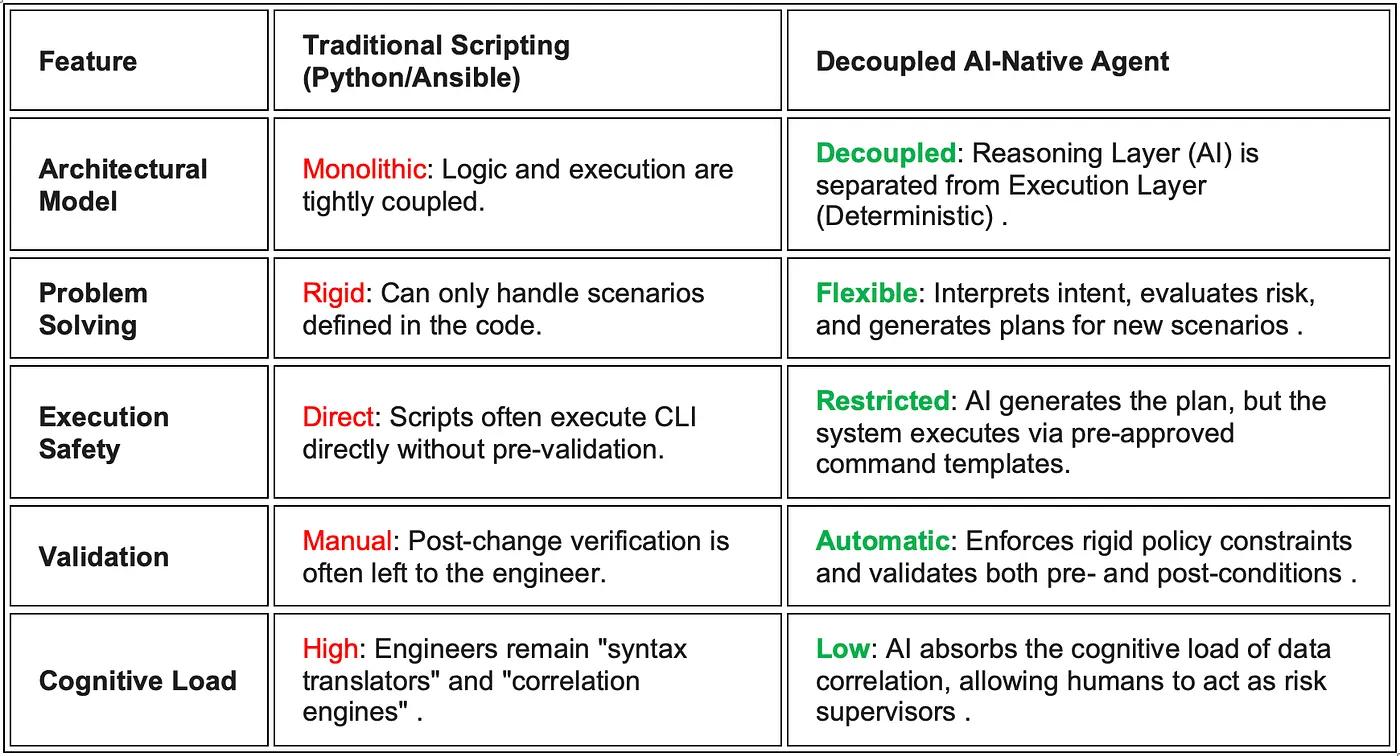
Here is how the Decoupled Architecture of a Network AI Agent compares to traditional Script-based approaches:
The Technical Breakdown
Why "Decoupled" Architecture is Production-Safe
The risk in AI automation explodes when you allow a probabilistic system to directly modify a production network. In our decoupled model, the AI never improvises execution.
The Reasoning Layer (AI)
This layer is powered by LLMs (like Llama3 via Ollama) and is responsible for understanding topology and evaluating alternatives. It is optimized for reasoning, not direct CLI access.
The Execution Layer (Deterministic)
This layer is locked down. It uses trusted libraries like pyATS and Genie to interact with the device using deterministic templates.
Is Your Team Ready to Move Beyond Brittle Scripts?
The transition isn't ideological — it's operational. When on-call fatigue starts affecting your reliability, it's time to look at a system where the AI thinks before it acts.
See this running in production — SD-WAN reference architecture